Subscribe to Jessica's exclusive newsletter

Subscribe to Jessica's newsletter

* indicates required
Showing posts with label women. Show all posts

Sunday, December 15, 2019

A Celebration of Unpredictable Worlds, Now Also Known as Mundos impredecibles!

My newsletter subscribers have already heard this news, but I’m thrilled to announce here that my five-star-rated short story collection, Unpredictable Worlds, has been translated into Spanish.

English-speaking readers, please see below the Spanish text for the special way Unpredictable Worlds is celebrating the birth of its Spanish sibling.

El libro con rinocerontes, matrimonios felices, mujeres que encuentran su esencia fuerte, y las miradas más raras al mundo del trabajo ya está disponible para disfrutar en el idioma que dio origen al realismo mágico. Estoy rebosante de orgullo al anunciar la llegada al mundo de la traducción de Unpredictable Worlds al español: Mundos impredecibles.

Encontré a un joven promesa de traductor, Carlos Orlando Castaño Franco, que tiene un don lingüístico genial y ha sabido transformar mis textos más extraños con un estilo ajustado a cada relato. He mirado personalmente la traducción de este colombiano para asegurar un español internacional pero no por ello falto de personalidad.

Estos relatos, que son un reglo ideal para el lector a la búsqueda de lo diferente e impredecible, son disponibles ahora para los siguientes dispositivos:

Amazon.com * Amazon.es * Amazon.mx * Barnes & Noble * Apple * Kobo

Y muy pronto lo verás en Google Play, si es tu mercado preferido.

¡Celebra conmigo! ¡Hazte con tu ejemplar de Mundos impredecibles ya!

Una edición en tapa blanda está prevista para el año 2020, ¡que se acerca!

Seeing Unpredictable Worlds in Spanish makes me feel like celebrating! So for those of you who don’t yet have Unpredictable Worlds in Kindle yet, this is your opportunity! Get it 75% off for two weeks only, now through December 31. The new year will see the price go back up!

Nowhere else can you get so much zaniness for only 99 cents!

You might have 99 problems, but a source for strange stories will not be one!

Makes a perfect Christmas gift for that reader in your life eclectic tastes who you’re never sure has read a certain book yet or not. Trust me, they haven’t read this one yet.

Sale valid in equivalent currencies on all Amazon sites.

My publisher has also decided to end 2019 with a bang. Awash in Talent is only 99 cents in ebook for the month of December. The latest (5-star!) review says, “A great learning experience of perspectives and thought. Stories that explain real-world phobias. Excellent writing.”

Get the 75% discount on Amazon US, and you’ll be all set for some original reading in the New Year.

Tuesday, August 28, 2018

Seeking Queen Violante

Lords of all we survey at the top of Allariz
All photos in this post 2018 Jessica Knauss unless otherwise specified. 
"I didn't even know Alfonso X had a wife," said a Spanish friend of mine the other day.

Of course he had a wife—he was the king and needed legitimate heirs. But while Alfonso X, one of the obsessions of my life, is known to everyone in modern Spain, you don't hear much about his bride, Violante.

While I was studying for my PhD, I heard of a famous scholar of Spanish history who thought of writing Violante's biography. He soon learned why none exists: there just isn't enough information about her to fill a book.

"The Castle," a rocky outcrop at the top of Allariz 
Violante (a modernized version of this name is Yolanda) was a princess of Aragón, daughter of Jaume the Conqueror and Violante of Hungary. Some sources claim that she married Alfonso when she was only ten years old. Papers were drawn up in 1246, and there may even have been a ceremony, but the marriage was probably not consummated until after she had her first menses.

The lack of information about Violante in a court where it seemed everything was written down, and the existence of two or three bastard-providing lovers of the king, have led some scholars to believe that the marriage was not happy. However, Violante and Alfonso had eleven children together, a number that seems above and beyond strict duty.

Violante in a thirteenth-century manuscript, Tumbo de Touxos Outos.
Another presumed portrait, from the Libro de ajedrez, is in this blog's banner.
Wikimedia Commons 
The most lovely evidence that the marriage had tenderness and strength appears in the Cantigas de Santa Maria. Cantiga 345 is full of politics and war, but in the pertinent lines, King Alfonso has a dream that wakes him up. He turns to Queen Violante, who is in the bed next to him, exactly where a beloved spouse should be. Would the Cantigas composers mention this detail if it were false? What reason could they have to make up something like that? What's more, when Alfonso describes his dream to his bedmate, she responds that she's had the same dream. The same dream! That kind of thing is soulmate territory. The king and queen stay together, taking necessary action and celebrating the happy results together, through to the end of the song.


I knew only two other facts about Queen Violante.

One, during the emotionally taxing confusion over who should inherit the kingdom when Alfonso's and Violante's firstborn son was killed in battle in 1275, the queen fled back to Aragón with her two young grandchildren, who stood to gain under Alfonso X's new laws. She eventually returned to court and must've made some kind of peace with her husband and second son, although nothing much more is said about her.

Typical Galician grain storage at the entrance to Allariz
Second, she survived Alfonso X by many years. He died in 1284 and Violante passed away in 1300. The main event recorded about her widowhood was that she founded a convent in the town of Allariz in what is now the province of Ourense in the region of Galicia.

I imagined Violante living out her days in the rainy gray weather of Celtic Galicia. For my birthday this year, I wanted to see the place where my fellow widow lived in constant sorrow after the love of her life left her all alone in the world.

Allariz's Praza Maior features the Romanesque
Church of Santiago, which Violante probably visited. 
I've had help and company for many of my travels over the past year, for which I'm keenly grateful. But this trip had to be solo. All told, I spent more than two hours my first day in the capital of Ourense researching how to get to Allariz and back without my own car and what to see once I got there. I mention this because the character of any travel is influenced not by the destination, but by the journey.

I imagined Violante felt lonely even surrounded by a royal retinue when coming to settle in this green land. Although I was taking taxis, city buses, and intercity buses just as alone, I did it with a sense of accomplishment I could never have achieved from my shotgun position in a friend's car. Those bus rides were, in a way, the culmination of all my years of studying the Spanish language and the history of Spain.

The Galician flag blends in with the Galician sky at the top of Allariz 
I arrived in Allariz—a big spa town, as it happened—before the convent museum was open, so I headed to what the locals call "The Castle." It was a huge rocky mound with no man-made structures except for a white and blue flag of the region of Galicia that waved stiffly in the strong breezes.

I felt like a queen at the top of that rock, looking down at valleys, so many green trees, and roads and houses. Would this have been enough after thirty-two years as the queen of an entire dynamic country? I inhaled the clear air, cool the way August mornings can be with their powerful gusts, and thought that yes, it could be plenty. I recognized the influence of my departed husband in that assessment, and wondered if Violante would ever have agreed.

Convent of Santa Clara, Allariz 
That's why I made this trip: to learn more about Violante. The convent museum was just opening as I got there. It's enormous... and not very medieval.

Violante founded the convent in 1286 with her son, King Sancho IV, and decided to be buried here, but precisely because it was a royal convent, it had plenty of money to do complete overhauls with changing architectural tastes, and almost nothing of the original convent survives. A fire in the eighteenth century obliterated most of what would've been recognizably Gothic. This convent has the largest cloister in Galicia, but no visits are allowed.

Santa Clara with the Church of San Benito 
I scoured the convent museum in search of what I'd come looking for. Many reliquaries and liturgical items were of fine artistic quality, but Baroque. Even the Gothic artwork on display was from after Violante's time. Then, in a room all by itself, this:

The Virgen Abridera (opening Virgin) was made in the thirteenth century from a single elephant tusk (not okay to do today—don't even think about it), at the behest of Queen Violante. When closed, it looks like a finely carved ivory of a Virgin and Child in the cheerful Gothic style of the thirteenth century.

Opened, it becomes a triptych showing Jesus's birth, his Ascension to Heaven, and how Mary was made the Queen of Heaven by her son.

The Nativity scene is flanked by an Annunciation in two parts, with Gabriel on the left and the Virgin on the right. On the left of the Ascension, the angel announces Jesus's Resurrection at the tomb, and on the right, Jesus appears as the Holy Spirit to the Apostles. Mary's coronation is flanked by angels holding candles.

The fine details, the remains of medieval paint, and the craftsmanship in the hingework display the highest quality and remind me of my favorite Gothic art, the illustrations of the Cantigas de Santa Maria.

The back of the sculpture shows how Mary's body adjusts to the curve of the tusk out of which she was carved.

This closeup of the right side shows its 3-D, wedge shape.

This sculpture had incredible presence. It told all its stories with joy and loving care. Through the ages, anyone who really looked at this ivory has probably been moved in a positive way. In the absence of many facts about Violante's life, I got a visceral feeling for her personality by appreciating one of her possessions.

The opening Virgin also seemed to me an apt metaphor for where I am with widowhood: It rips you open. What you find inside determines the quality of the rest of your life.

Neoclassical fountain in the convent plaza, Allariz 
Most importantly, in Allariz I learned that the widowed queen did not stay at this convent for the rest of her life, the way I'd assumed. She lived where she was likely happiest, her home in Aragón. She was returning from a pilgrimage to Rome when she died in the Pyrenees mountain pass of Roncesvalles.

Good for her. Not shutting herself away, but going where she wanted and living in a way that brought her happiness? That's a widowhood example to follow.


Monday, November 21, 2016

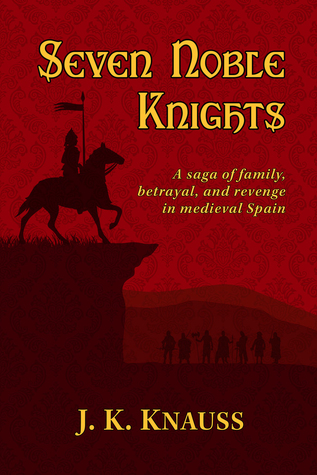
Seven Noble Knights Characters: Long-Suffering Justa

Perennially overworked Justa 
Justa is one of the characters I added to the mix from the original epic story I based Seven Noble Knights on. In the old draft of the story that no one will ever see, Justa was conceived as a snarky maid for Doña Lambra, the main narrator, and a commentator on the story.


When I started over, I decided Doña Lambra was negative enough. She didn't need a snarky sidekick. So Justa became a sweet girl who longs for a normal life, but her ties to Lambra won't permit the freedom to pursue it. She took on more of the characteristics associated with her name, which is the same as an early Spanish martyr saint, and whose meaning has to do with fairness or justice, and then it turned out that she needed a snarky foil. That sassy role is filled by Gotina, a minor character.

Using the distaff and watching the kid 
Partly because my critique group really liked her character, and partly because it fit brilliantly into the plot, Justa turned into a major character with a fairly complex arc. When I write the sequel to Seven Noble Knights, it will focus largely on Justa, the decisions she makes before and after Seven Noble Knights comes to a close, and their ramifications.

She was born into a family of the minor nobility the same year as Lambra, and she looks enough like her that they could be sisters. In Part Two of Seven Noble Knights, our hero, Mudarra, is afraid she might be Doña Lambra when he first meets Justa. She comes into Lambra's household as a foster child when her parents are killed in a border raid, and lives as if she were Lambra's sister until Lambra's parents are killed. From that moment on, Lambra treats Justa as her personal servant, and Justa suffers it because she has nowhere else to go. The ties created when Lambra's family took her in are not easily broken, but everyone has their breaking point. When Justa finds hers, the story comes to an end.

It's a pretty important role for someone who started out as a snarky maid.

This is artist Ayal Pinkus's rendition of Doña Lambra.
Justa looks a lot like her, but she never gets to throw a fit. 
The last chapter of Part One is devoted to Justa's point of view. She gets to fall in love and dream of possibilities beyond her bad-luck servile situation. The romance may not be coincidental: this is the novel's only Chapter XIII, which is the lucky number my husband and I adopted. In this chapter, Justa lets slip perhaps her most iconic line:

"She may control everything I do, 
but she doesn't have any secrets from me."

Smart readers who subscribe to my mailing list will get to catch a glimpse of how Justa's and Doña Lambra's characters were formed in a prequel story in December, just in time to celebrate the release of Seven Noble Knights!


Goodreads Book Giveaway

Seven Noble Knights by Jessica Knauss

Seven Noble Knights

by Jessica Knauss

Giveaway ends December 14, 2016.
See the giveaway details at Goodreads.
Enter Giveaway

Saturday, January 30, 2016

Cover Reveal and the Beginnings of My YA Paranormal Adventure Set in Providence

It's the book with telekinesis, pyrokinesis, and psychic powers. Just as importantly, it's the novel with a field study in Ethiopia, a snowy trip to Boston, and the wonders of Waterfire in inimitable Providence, Rhode Island. It's Awash in Talent, and it's nearly ready to knock your literary socks off!

The amazing cover was created by Jasmine Green. It captures the female focus of the book and the way their Talents can make the characters feel, at the same time, invincible and about to drown.

I'm sharing the cover with you on the auspicious occasion of the beginning of Awash in Talent's Kindle Scout campaign. This is your opportunity to select Awash in Talent for publication by Kindle Press!

The link takes you a rather attractive page with the cover, the tag line (So much Talent can kill you.), an excerpt from the beginning through most of Chapter 2, a short bio, and three questions and answers about the book. It also shows a "Nominate" button. If you think Awash in Talent is worthy, all you have to do is click the "Nominate" button before February 29 (Leap Year Day!).

This simple act will get you three major benefits:

1. If Awash in Talent is chosen for publication (because you nominated it!), you will receive an exclusive edition of the novel for free before anyone can buy it! You'll be under no obligation to read it or to leave a review, although that's what Amazon (and I) will be hoping for.

2. You will have helped an author's dreams come true. How great will that feel?

3. You will be the proud owner of my gratitude. I will remember you when my writing career takes off. The value of this benefit is incalculable.

Here's a little more about the novel. At the link, you can also read an excerpt that introduces Emily's world. More beautiful graphics and descriptions are to come in the following weeks.

Emily can’t escape her annoyingly Talented telekinetic healer sister by going to a university 3000 miles away, in Providence, or even by doing a field study in Ethiopia. Why don’t people give credit where credit is due?

Kelly is forced to attend a pyrokinesis school/lockdown facility, but she must escape and bring Emily’s healer sister to Boston—her mother’s life depends on it.

Appointments with Emily might drive psychic therapist Patricia insane. Meanwhile, Patricia falls ever deeper into her husband’s selfish, cruel trap. In Providence, Friendship is a one-way street.

Awash in Talent is a novel in three interrelated novellas, all set in Providence, Rhode Island, where telekinetics, firestarters, and psychics attempt to function in a largely un-Talented society unappreciative of what they have to offer. Love/hate between sisters, mother and daughter, scared teenagers, a mismatched married couple, adult female friends, and an obsessive and the object of her affection are all put to the test.

The Kindle Scout campaign runs from now until midnight EST February 29. It's easy—just one click brings so much joy! Thank you so much for your consideration.


Monday, December 7, 2015

Like to Listen?

It's here! Every audiophile's dream. Tree/House, the strange little novella that inspires everyone who reads it, now comes to you via the lively professional talent of Melissa Moran.

It's available on iTunes, Audible, and Amazon. Click on the links to find compelling audio samples.

If I may say, it's priced very reasonably for this much imagination and creative talent (the voice artist's). And yet, there are a couple of ways you can get it for no money at all.

1. Contact me (in a comment here or at Facebook or Twitter) for a free download code from Audible! I would, of course, love it if you enjoyed Tree/House in audio and left a review after using one of the limited number of codes I have available. The important thing is to enjoy it.

2. Join Audible's first month free and make sure Tree/House is the first book you download. If you love audiobooks, you'll want to keep your subscription for only $14.95 a month. That charge includes one audiobook per month and 30% off additional ones. If you remain a member in good standing for 61 days (three months) after you get Tree/House as your first download, I get a special bounty payment. This is the option for you if you love to listen to books and want to give yourself (and me) an amazing gift.

Having Tree/House brought to life in this way has been a dream come true. I've personally listened to it all and am amazed at how well it's turned out. But it has cost me a significant amount of money to produce. Like everyone I know, I work very hard for the small amount of money I earn, so this was a big decision. I hope I have some avid reader supporters to help me get back my investment. Every download helps! Really. Thank you.

If you prefer to read it and interpret it for yourself, a new edition of Tree/House is also available in many electronic and print venues.
Kindle • iBooks • Nook • Kobo • Smashwords • Inktera • Blio • Many other ebook retailers • Softcover • Softcover Indiebound • Softcover Amazon •  Softcover Barnes and Noble • Request it at your local library or bookstore

Monday, April 13, 2015

Cover Reveal: New Amazing Book of Stories Ready for Bargain Pre-Order

It's almost here. Unpredictable Worlds releases May 15!

If you've ever despaired that my published and prize-winning fiction is all over the web, in no single place, and that I have many more stories to amaze you with, but they haven't been picked up yet, despair no more! Unpredictable Worlds has it all, and more!

The synopsis:

A teacher controls her students with an edible microchip. A reporter turns into a rhinoceros. A couple's efforts to eat local go frighteningly awry. If you're looking to be surprised, puzzled, or just plain entertained, pick up this omnibus. There's something for everyone! 

More than twenty years in the making, Unpredictable Worlds contains all of Jessica Knauss’s published and prize-winning short fiction as of March 2015 and a few of her best stories never before seen in print or ebook. Zany plots and outrageous characters will stretch your belief and tug at your heart. 

WARNING: These stories contain exaggeration, elision, and disregard for “the real world.” Some even exhibit a tone of blatant optimism. However, they respect human speech patterns, admire good grammar, and hold proper punctuation in the highest regard. 

Enjoy!

The cover features details from a French painting that dominates one of the galleries at the Worcester Art Museum. I find the turbulence and the barely visible hand reaching out of the water disturbing. I hope it captures the vaguely unsettling nature of many of the stories in Unpredictable Worlds.

Unpredictable Worlds releases for Kindle on May 15 with a softcover edition to follow. Seem too far in the future? It isn't so far when you consider this: Unpredictable Worlds is already available for preorder for only 99 cents. Once it's out there in the world, the price will go up, so save at least 66% now and have this strangely amazing book delivered to your device on release day.

Monday, June 30, 2014

"Sin of Omission" by Ana María Matute

2014 is shaping up to be a terrible year for the literary world in Spanish. I learned last week that the world has lost Ana María Matute, master of realism and pithy short stories as well as longer works that expose all the ironies of society.

What better way to honor her memory than with one of her stories? This is my humble translation of perhaps her most famous. Enjoy.

Sin of Omission
Ana María Matute


His mother, who had been all that was left him, died when he was thirteen. When he became an orphan it had already been at least three years since he’d last gone to school, because he had to make a living here and there, wherever he could. His only relative was his mother’s cousin, called Emeterio Ruiz Heredia. Emeterio was the mayor and had a two-story house on the town square, round and reddish under the August sun. Emeterio had two hundred head of cattle grazing along the slopes of Sagrado, and a beautiful daughter nearing twenty, brunette, robust, laughing and a bit dim-witted. His wife, thin and as hard a black poplar, did not speak gently and knew how to take charge. Emeterio Ruiz hadn’t gotten along well with that distant cousin, but he helped the widow out of a sense of obligation by finding her odd jobs. Then, although the mayor took the son in once he was an orphan, with no money or job, he did not look on him with sympathy, and everyone else in the house felt the same way.

The first night Lope slept at Emeterio’s house, it was under the grain loft. They gave him dinner and a glass of wine. The next day, while Ementerio was tucking in his shirt and the sun had barely risen to the roosters’ crowing, he called down the stairs, startling the chickens that had been sleeping on the risers.

“Lope!”

Lope came over barefoot with sleep in his eyes. He wasn’t very big for thirteen but he had a head that looked even bigger for being close-shaven.

“You’re going to be Sagrado’s shepherd.”

Lope found his boots and put them on. In the kitchen, the daughter, Francisca, had made potatoes with paprika. Lope wolfed them down, his aluminum spoon dripping with every bite.

“You know how it’s done. I think you walked the hills of Santa Áurea with Aurelio Bernal’s goats.”

“Yes, sir.”

“You won’t go by yourself. Roque the Medium shepherds around there, too. You’ll go together.”

“Yes, sir.”

Francisca put a loaf of bread in his knapsack, along with a small aluminum flask, goat fat, and cured meat.

“Get going,” said Emeterio Ruiz Heredia.

Lope looked at him. Lope had round black eyes that shone.

“What are you looking at? Go on!”

Lope left, knapsack on his shoulders. He picked up the crook, thick and shiny with use, that he kept leaning against the wall like a dog.

He was climbing Sagrado’s hill when Don Lorenzo, the teacher, saw him. That afternoon, in the tavern, Don Lorenzo lit a cigarette with Emeterio, who was throwing back a glass of anisette.

“I saw Lope,” he said. “He was heading up Sagrado Hill. Such a shame.”

“Yes,” said Emeterio, wiping his lips with the back of his hand. “He’s a shepherd. He already knows he has to earn his own living. Life is hard. That poor bastard Pericote didn’t even leave him a wall to lean on or a place to drop dead.”

“The bad thing,” said Don Lorenzo, scratching an ear with a long yellow nail, “is that the kid could be something. If he had the means, someone could make something out of him. He’s smart, very smart. At school…”

Emeterio cut him off with his hand in front of his eyes. “Yes, yes. I’m not saying he’s not. But one must earn one’s own living. Life gets worse with every passing day.”

He ordered another glass of anisette. The teacher nodded in agreement.

Lope arrived at Sagrado and found Roque the Medium by calling for him. Roque was a bit slow and had been Emeterio’s shepherd for about 15 years. He was almost 50 and barely ever spoke. They slept in the same mud hut, under the oaks, taking advantage of the shelter under the branches. They could only fit into the hut bending over and they had to go in on all fours, half crawling, but it was cool in the summer and warm enough in the winter.

Summer went by. Then autumn and winter. The shepherds didn’t go to town except on festival days. Every two weeks, a young lad brought up “rations”: bread, jerky, lard, garlic. Sometimes, a wine pouch. The summits of Sagrado were beautiful, profound blue, terrible, blinding. The sun, high and round, like an unmoving eye, reigned over the land. In the early morning fog, when he couldn’t hear the buzzing of flies or any rustling, Lope would wake up with the mud roof before his eyes. He would stay quiet for a while, feeling the body of Roque the Medium by his side, like a breathing log. Then, he would crawl towards the corral. His shouts were lost, useless and grandiose in the sky, mixed in with runaway stars. Only God knew where they would eventually land. Like rocks. Like the years. One year. Two. Five.

Once, five years later, Emeterio sent the lad for Lope. He had the doctor examine Lope, who had grown healthy and strong, like a tree.

“What an oak!” said the doctor, who was new. Lope blushed and didn’t know what to say.

Francisca had married and had three small sons who were playing in the town square. A dog approached Lope with its tongue hanging out. Maybe it remembered him. Then he saw Manuel Enríquez, a schoolmate of his who had always been behind in his studies. Manuel was wearing a grey suit and a tie. He passed by Lope and waved.

Francisca commented, “Good career, that one. His father sent him off to study and now he’s a lawyer.”

When he got to the fountain, Lope saw him again. Suddenly, he wanted to talk to him. But his shout stayed in his throat like a ball.

“Eh,” he said. Or something like that.

Manuel turned around to look at him and recognized him. It didn’t seem possible: he knew Lope. He smiled.

“Lope! Hey man, Lope…!”

Who could understand what he was saying? What strange accents men have, what strange words come out of the dark holes of their mouths! A thick blood was filling his veins while he listened to Manuel Enríquez.

Manuel opened a flat, silver case filled with the whitest, most perfect cigarettes Lope had ever seen in his life. Manuel handed one to him, smiling.

Lope held out his hand. Then he realized how rough, how coarse, it was. Like a piece of cured meat. His fingers weren’t flexible, they wouldn’t play along. How strange the other’s hand: a refined hand, with fingers like big worms, agile, white, flexible. What a hand, wax-colored, with shining, polished nails. What a strange hand: not even women had hands like that. Lope’s hand fumbled. At last, he took the cigarette, white and fragile, strange, in his hard, heavy fingers: useless, absurd, in his fingers. Lope’s blood stopped between his eyebrows. A blood clot crowded quietly, fermenting between his eyebrows. He crushed the cigarette with his fingers and turned around. He couldn’t stay there, not even with Manuelito following him in surprise, calling, “Lope! Lope!”

Emeterio was sitting on his porch in short sleeves, watching his grandchildren play. He was smiling at his oldest grandson and resting from work with a bottle of wine within reach. Lope went directly to Emeterio and saw his grey eyes, questioning.

“Go on, boy, it’s time you go back to Sagrado.”

In the town plaza there was a square, reddish rock. One of those rocks as big as melons that the boys take from some fallen-down wall. Slowly, Lope took it in his hands. Emeterio looked at him comfortably, with a mild curiosity. His right hand rested between his belt and his stomach. He didn’t even have time to take it out: a muffled thud, the splattering of his own blood on his chest, death and surprise, like two sisters, came upon him just like that.

When they took him away handcuffed, Lope cried. And the women, howling like wolves, wanted to hit him and followed him with their veils raised over their heads, outraged.

“My God, the one who took you in. My God, the one who made you a man. My God, you would have died of hunger if he hadn’t taken you in…”

Lope only cried and said, “Yes, yes, yes…”


Wednesday, June 18, 2014

A Marriage That Sparked Rebellion, Sieges, and Battles

Urraca's royal signature 
Don't miss my post on Unusual Historicals today. In the category of "Happily Ever After — Or Not," Urraca of Castile and Alfonso I of Aragón may be the most Or Not in all history! No one wants to read about a happy marriage, anyway.

Monday, January 20, 2014

Magic Realism, The Class, Part II

One of the tools we used in the magical realism class I took in December was this video, which answers any questions writers might have about how to proceed and what to do as a writer in one minute and twenty-nine seconds.


We also studied "Harrison Bergeron" by Kurt Vonnegut. For me, it still doesn't qualify as magical realism, but it is an astounding story that everyone who likes to write and all people who like to read would do well to read carefully. Notice how it executes all the advice in the video! He practices what he preaches. Admirable, and I hope, inspiring for you all.


Magic Realism, The Class

by Rob Gonsalves
I've mused on this blog about magic realism before (here and here). It seems to be more acceptable in the mainstream as time passes, with stories like Life of Pi, to take just one example, directly addressing the question of what is the breaking point of a reader's stretched credibility. This last December, I took a course in writing magic realism online from the T. J. Eckleburg Workshops, mainly because I wanted to get a firmer grasp on what exactly it is and whether I still write it.

Overall, it was a great class. The other writers had some spectacular talent, I got to read some great stories, and I wrote two of my own. We're supposed to write three, but the final assignment prompted me to think about the last part of the Providence trilogy (which is paranormal, not magical realism) instead. It's wonderful when stories take over.

In the class, magic realism is defined as a sweet spot on a continuum between realistic fiction and fantasy. The overall world of the story is realistic, but magical or fantastical elements appear in a fleeting way that could be the result of perception or point of view. My favorite part about magical realism is that the magic is not explained. It's the reader's job to decide either what's real or what the magical element means in the realistic context, or both.

In masterpieces like "A Very Old Man with Enormous Wings" by Gabriel García Márquez, for example, the appearance of a winged man in the village is factual, but his meaning is the cause of lively debate both within the text and for the readers. On the other hand, this course considers "The Yellow Wallpaper" by Charlotte Perkins Gilman an early work of magical realism because of the way the author toys with perception. (Both are incredible, worthwhile stories. Read them immediately.)

When I was writing in college, I was a classic magical realist. It's not that I had the amazing discipline necessary to maintain the balance described above, but that I was reading so much twentieth-century Latin American literature and being so thrilled and inspired by it. However, lately I've tended toward paranormal and out-and-out fantasy. It might be because I can maintain the balance of magic realism in short stories, but not in the longer pieces I've been writing.

I'm going to be revising the stories I wrote for this course and letting my imagination run with the idea of how to extend a magical idea over a longer piece. It was insane to take such an inspiring class right before making what may be the biggest, most important, trans-state move of my life, but a little insanity puts the vigor in my writing, right?

Wednesday, September 4, 2013

Book Debut and Interview: The Fiery Alphabet by Diane Lefer

More than a year ago, toward the end of my time in Tucson, Diane Lefer sent her novel The Fiery Alphabet to me at Fireship Press. I loved it for all the reasons the COO didn't: It's smart, it's not formulaic, and it tells a story most women today can sympathize with. When my colleagues and I all left Fireship for various personal reasons and got together to found Loose Leaves Publishing, I wondered if that crazy wonderful novel was still looking for a home and, with my new partners' blessing, I asked Diane about it. (Insert incredible amounts of work and joy here.) 

I'm inestimably proud of this book and the wonderful response it's already received from reviewers. The Fiery Alphabet makes its official debut tomorrow, September 5. 

Diane Lefer: Thank you for the introduction, Jessica. When I sent you The Fiery Alphabet, I didn't dare admit the manuscript had been making the rounds of publishers for 26 years. I thought, who on earth would want to publish a book that had already racked up so many rejections? Well, you did. You know, years before, I had drinks with a prominent editor in New York. She said, "If I used my own taste, I'd be betraying the trust the company has in me." That's why I have such love and appreciation for small independent presses like Loose Leaves. You get to use your own taste and judgment. And I hope my experience can encourage other writers to never lose faith or give up.

JK: That's exactly what Loose Leaves aims to do: give good books a chance in this bizarre new publishing milieu. What happened during the intervening 26 years?

Diane Lefer
DL: I had agents, I lost agents, I fired agents, and I tried to place the manuscript myself, but the policy in mainstream publishing changed and all of a sudden even editors who knew me weren't allowed to read work I sent directly.

Even before that, The Fiery Alphabet had a long gestation period. It's a book I'd wanted to write since I was a kid and saw a TV show about the occultist Cagliostro. I wasn't that enthralled with his magical powers but very impressed with the idea that a person could be an actual historical figure – even a famous one – and yet shrouded in mystery. Like Shakespeare. As a kid, I loved Shakespeare because he wrote about witches and ghosts, and this unlikely pair became the creative polestars of my youth: Shakespeare and Cagliostro.

Then, in the early 1970's, I was in Brazil during the brutal dictatorship. People were being detained, tortured, disappeared. Any gathering of students was dangerous and forbidden but what happened was, if you sat down in a cafe with a book, a student would join you, hoping for a good conversation. That's how I met a young writer, Mauro Costa, who had just read Jung's Psychology and Alchemy and was eager to discuss it. Unfortunately, I had never read it. I hadn't even heard of it, but I sought out a copy as soon as I returned to the US and the book awakened an interest in the Divine Feminine – the archetype with such beautiful names: Queen of Heaven, Rosa Mystica, Star of the Sea –  and reawakened my desire to write about mysticism and Cagliostro. I learned his real name was Giuseppe Balsamo: one mystery about him solved. But another ten years passed before Daniela presented herself to my consciousness and I began to write.

I worked on the manuscript for several years. Once I started sending it out – and by the way, I avoid using the word "submit." I think it was Muriel Rukeyser who said offer your work, but don't give up your power. Never submit! – there was a lot of discouragement. The very first rejection began with the words, "Daniela is a passionate creature, but her passion is for learning. Intellectual women aren't interesting." As though there's something wrong with being curious about the world and wanting to know and understand and experience as much as you can – which for Daniela definitely includes love and sexual desire. I took the criticism very personally because I came of age during an era when girls weren't supposed to be smart. Some adults actually expressed their sympathy as they assured me I would never fit in and my life would be very hard. A few took a more optimistic view of my future: they said I might get to marry a doctor. Of course, in the novel, Daniela's intelligence lands her in more trouble than mine ever did. But the manuscript (and I) finally lucked out to find a smart woman editor who had the authority to make an offer without having to sneak it past the gatekeepers.

Though I did a lot of research, I didn't really think of my novel as all that high-brow. Several years before I began writing it, I was broke and had to borrow rent money. A nonfiction book project I was working on for which a contract was supposedly being drawn fell through. I ended up getting out of debt by writing two Regency romances, that is, romances set in nineteenth-century England during the time King George III was too mad to rule and his son, the Prince Regent, ruled in his stead. (The books were published under a pseudonym because the editor said, "Diane Lefer isn't a romantic name.")

Writing those books was a great experience. Getting paid for my work? What a concept! But also, I admit, my orientation as a writer had always been to concentrate on my characters' inner lives. I was not very observant of physical reality. The Regencies, however, had to be written to a formula which went so far as to specify not only when the romantic encounters were to occur (and how far they could go), but also how often descriptions of food and clothing and furniture had to appear on the page. This was excellent training for me. Of course, in The Fiery Alphabet, I wasn't writing to formula and didn't include quite that much sensory detail. Most of the novel is in the form of Daniela's journals and a person writing a journal takes much of her world for granted and doesn't describe everything the way an outside observer might. But the Regencies taught me to pay attention to the world of the senses.


Diane's Artemis of Ephesus
JK: What first drew me in to The Fiery Alphabet was the fictionalized Translator's Preface, in which you have a subtle adventure in Turkey. Tell me about the research.

DL: I went to Turkey to visit the harem and the archaeological sites associated with Goddess worship: çatal Hüyük, the world's most ancient city; Ephesus with its temple to Artemis. I brought home a small statue of the goddess and one day, trying to get all the dust off her, I made the mistake of washing her. The statue started to melt. I saved most of her!

In order to immerse myself in Daniela's world, I tried to read everything she would have read, though often in translation as, unlike Daniela, I don't know Latin, Greek, and Hebrew. I read Casanova's memoirs – useful but boring. I needed special permission to access eighteenth-century obstetrical manuals. I stared at Piranesi's etchings of Rome until I could dream myself into them. So, OK, I knew there was a lot of ... erudition in The Fiery Alphabet, but I believe I'd also learned a lot about just telling a good story.

JK: Did you revise much during the 26 years?

DL: At some point I changed the title. The manuscript first made the rounds as "Ardent Fire," which is actually a phrase Balsamo quotes from St. John of the Cross, but people thought it sounded like the title of a romance novel. Daniela does fall in love with Balsamo, but editors who expected a more familiar romance novel were disappointed. Marketing isn't just about ads and blogs and reviews. I understand now it's about a cover and a title that don't mislead potential readers, that help a book find the readership that will most enjoy it. I've been happily stunned by all the positive reactions to the cover Loose Leaves designed and I appreciate the way you all wanted my input.

Over the years, I did some revising and cutting. I found myself simplifying the manuscript – without, I hope, dumbing it down. For example, in the original draft, Daniela writes two journals. One she leaves lying around hoping Balsamo will find it and read it and love her for it. The other is private and in it she writes what she really thinks and feels. Then A.S. Byatt published the novel Possession which also features a public and a private diary. I was afraid people would think I'd stolen the idea from her so I very reluctantly rewrote the novel. Daniela has only one journal now. And though I still think there's psychological truth in the original concept, I ended up happy I made the change. The revision does make a somewhat complicated novel more readable, easier to follow. After all, we got that review from ForeWord calling the book "complex and thoroughly satisfying" – which sure beats someone saying it was too damn complex to read.


JK: That issue of ForeWord is out now in Barnes and Noble and many other venues. See the review here. Thanks for coming by, Diane.

Find Diane's website here. If you want to know more about The Fiery Alphabet, take a look at these additional discussions:

Eliza Gales Interviews
She Writes

The soft cover is available here, from Indiebound, anywhere fine books are sold, and directly from Loose Leaves

Ebook editions: NookKobo | Kindle | Kindle UK | Kindle Canada