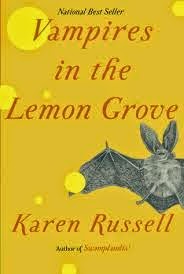
I may well be the last person to read Vampires in the Lemon Grove. (I hope not! I hope many more readers discover its delights!) But I just heard the news of the title story from Karen Russell's first collection being developed for ABC. That is a beautiful event that deserves celebration: a wonderfully strange piece of literature of the type I most admire and aspire to, translated to other, more popular media! So I'm going to take this opportunity to talk a little bit about her second story collection, which happens to have a title appropriate for the week before Halloween.
It's hard for me remember that Karen Russell is a bestselling author. Of course I'm glad she is and don't begrudge her any other honors—just the opposite. It's just that when I read her stories, I always think she's speaking directly to me and no one else could possibly enjoy this writing as much as I do. That illusion of intimacy when apparently the books appeal to tons of other readers is the sign of literature that will last.
There are some pretty creepy stories in Vampires, if you like that kind of thing. Each story is memorable for its startling way of presenting weird images as familiar. Take, for example, a mangy seagull. Anyone who's spent time living near the sea knows them to be pretty annoying. But as annoying as the seagulls in Karen Russell's world? I had no idea. And most readers know that if a character bullies someone, he'll be haunted—but never before quite like this.
I don't lean toward the darkness in general. While there's plenty of darkness here, in contrast to the first collection, in Vampires it serves to cause real change in most of the characters and, in some cases, to contrast with the light at the end of their journey.
For me, the most amazing journey takes place in "The New Veterans." A massage therapist with her own issues comes into her power as a healer when working on a man with PTSD. In her dealings with him, the implicit question is whether it is more important to uphold "the truth" or to heal. I know what I think, and apparently Karen Russell agrees.
If you've missed Vampires in the Lemon Grove so far, don't hesitate to pick it up now. There's something here for every reader.
Subscribe to Jessica's exclusive newsletter
Tuesday, October 28, 2014
Monday, October 13, 2014
New Pictures of the Rarest Rhino
Five species of rhinoceros survive today. The smallest in
number is the Javan rhino.
It is often said that the Sumatran is the most endangered
species of rhino, even though at least three times as many of them live in the
wild. Javans may be considered less under attack partially because of their
elusiveness: in order to poach a rhinoceros, you have to be able to find it. No
Javan rhino has survived more than a year in captivity since a male at the London
Zoo, which passed away in 1885. Many recent expeditions have spent weeks on the
trail only to come back without a single camera-trap photo. About 35 of these
rhinos are estimated to live today in the jungles of the Ujung Kulon Peninsula.
This is a geographical area of 1206 km2 on the western tip of Java,
in stark contrast to their former range all over Southeast Asia.
Here’s where the story gets crazy: Ujung Kulon is in the
path of destruction if/when the Krakatau volcano erupts again. This is the reason
the area has been mostly abandoned by humans, allowing extraordinary flora and
fauna to flourish in their absence. It also creates the terrible possibility
that entire species—including the Javan rhino—will be utterly wiped out. My
flash fiction “The Last Ultrasound” originally included a breakneck plot in
which Krakatau erupts, but I abandoned it as too unwieldy for such a short
story. Plantations of invasive palm trees that the rhinos can’t use further
jeopardize their modest habitat.
To say that it’s unlikely I will ever see a Javan rhino in
person is an understatement. Until recently, grainy low-res camera-trap photos
were the only glimpse anyone ever got of these mysterious beings. The wonders
of crowdfunding recently permitted professional photographer Steve Belcher to spend unprecedented patience floating along the rivers of Ujung Kulon in search
of these rhinos—and he’s returned with some gorgeous treasures.
Also known as the lesser one-horned rhino, Javans have the
same basic shape and coloring as Indian rhinos, but tend to be much smaller.
Their skin lacks the bumpy quality of the Indian rhino and their features look
softer, perhaps more juvenile. Unique among the species,
it appears that females never grow the trademark rhino horn. Javans are also
the best swimmers of all the rhinos. Rather than just standing in shallow
water, they appear to be able to stay afloat and travel with purpose through
the waterways of Ujung Kulon.
These pictures allow us to appreciate the finer details and
perhaps some of the life force behind Javan rhinos even though we will never be
in their presence. Let’s hope human beings and the massive volcano can leave
these lovely creatures to flourish for much time to come.
Wednesday, October 8, 2014
A Red-haired Beauty
| A Greater One-Horned or Indian rhino (with ravishing locks of blond hair on the ears only) at the Cincinnati Zoo. |
I recently made a promise to travel to Cincinnati, where a
brown-eyed, red-haired beauty awaited, but probably not for long. The urgency
to the pledge is that Harapan (“Harry” to his keepers) is currently the only
Sumatran rhinoceros living outside of Indonesia. I believe he’ll soon join his
kin and help freshen the DNA of the species.
Within Indonesia, only about 100 Sumatran rhinos thrive
under heavy guard from passionately dedicated rangers. If only other people
would leave them to it, the rhinos could thrive without the guard, but that’s the
current state of the world.
| A lovely black rhino at the Cincinnati Zoo. |
Sumatran rhinos are special beyond their rarity. They’re the
only direct descendants of the extinct wooly rhinoceros, and they display that
inheritance proudly with a unique coat of red hair. In contrast to their wooly
ancestor, Sumatran rhinos are the smallest of the five remaining species,
averaging a tidy half ton instead of an entire ton.
I’ve been the in presence of black, white, and
Indian rhinos before and loved them all. I have a completist
tendency, and when I heard about Harapan, his history as part of the success of
Cincinnati’s breeding program made him all the more meaningful. When my day job
slowed down, I asked my husband if he’d like to go on a road trip. We were concerned
that we might drive nearly a thousand miles to arrive at an empty enclosure, so
we wrote to the zoo to ask if there was any way we could be sure Harapan
would be on public view on a given day. In the end, there was no way to be sure
because of the Sumatran rhino’s “delicate” nature. Off we went, fueled by
faith, through gorgeous fall colors and wind and rain. We stopped to see
friends, but the rhino tension just kept mounting. Would we see this rarity or
just go home?
When we awoke on the
day, the rain was coming down so hard, I had the doom-and-gloom idea that
Harapan wouldn’t even think about going outside to get pummeled by water and struck by lightning. Then
my husband said the rain would keep the zoo from being very crowded, so we’d
have him all to ourselves. I was a swirling yin-yang of hope and pessimism.
Coming in the zoo entrance, the Sumatran rhino area is
tucked away where you have to be determined to see it, but if you are, it’s the
first thing on the left. Visitors must go down a twisting ramp that keeps the
exhibits tantalizingly out of direct view. I was running down the slope,
holding my hood over my head against the rain, to see that the enclosure is
covered by decorated tarps so no downpour can bother Harapan overmuch. All
of a sudden, I saw him, coming out of his pool as if it were a day at the spa.
I shouted back to my husband, and even to myself I sounded like Linus in It’s the Great Pumpkin, Charlie Brown:
“There he is!” I guess we had the appropriate amount of sincerity.
| Harapan the Sumatran rhino. |
What a handsome young rhino!
My impression is that Sumatran rhinos don’t photograph well.
Before I went to Cincinnati, I couldn’t get much sense of personality from the
pictures I’d seen. The camera picks up wrinkles and hairiness before what we
might think of as more positive traits and often darkens the russet-colored
hair. But as Harapan moved about with the casual grace of someone who knows
he’s loved, I could find no fault with him.
He daintily probed the mud hole, considering whether or not
he’d like to have a good roll, until he did, slathering his entire left side.
He looked a little like the Phantom of the Opera at that
point. He rubbed against a post, looking as if he were in Indonesia marking the
trees with his mud. He may have the chance to do that soon! Some
more investigating all over the enclosure led him to the conclusion that the
only way to clear the mud out of his eye was to get back in the pool.
At :43 he swipes near his eye with his three-toed foot—not a
typical move for a quadruped, I don’t think.
Soon after, Harapan had had enough of our adoration and
“left the building.”
“These ten minutes were worth the thousand miles—or more,”
said my husband. I couldn’t have said it better. We are fortunate beyond words to have been able to make such a meaningful journey. We now number among the lucky few who have spent a little time with a rare and enchanting Sumatran rhinoceros.
The sad fact is that there is another rhino species with
even fewer living individuals than the Sumatran: the Javan. More on those extraordinary
creatures coming soon.
Monday, September 29, 2014
Road Trip, With Windmills
| Consuegra, Castilla-La Mancha, Spain |
The yellow plains undulate before you like a gigantic quilt.
As you glide along, if you’ve seen three other cars today, it’s a lot. The
quiet hum of a Spanish-engineered air conditioner insulates you from the
explosive, desiccant sunlight. There are four big indicators that you’re not in
Nevada or Arizona:
The three cars you’ve seen are Renaults or SEATs, like
yours.
The speedometer shows a number that seems impossibly huge
until you remember it’s in in kilometers.
There are no advertising billboards. Only the wordless Osbourne
bull creates a black shadow on the horizon.
Over the a. c., you hear strumming
guitars, hollow cajones, rhythmic
clapping, and voices that are somehow mournful and the most joyous sound in the world.
Driving through Castilla and Andalusia is one of the
greatest simple pleasures I’ve found in life. I last did this with the man I
love beyond words during our honeymoon five years ago.
Recently, I discovered that through the wonder of the internet,
I can listen to radio stations from Spain right here in the USA. The full
sensory experience of Spanish road trips came rushing back to me. I want to
send out my sincere thanks to whomever set up this miraculous web streaming.
And wish a happy anniversary to my sweet husband!
¡Olé!
Monday, September 22, 2014
World Rhino Day 2014
It’s here! The greatest day of the year!
If you don’t know of any events taking place near you, you
can still make a contribution simply by staying informed about rhino problems and also about what makes them so wonderful.
The Stop Poaching Now! campaign includes practical, on the
ground ideas for deterring and catching poachers as well as decreasing demand
for horn, which is the only overarching solution.
On October 4, the Global March for Elephants and Rhinos gives everyone a physical activity to do in
support of anti-poaching efforts. There may be a march in a city near you!
My husband and I have supported rhinos every way we can
feasibly think of, mainly with small monetary donations. Our up-close
experience with two gorgeous white rhinos helped increase the joy quotient in
the world, which is no small thing.
Additionally, on this day of concentrated rhinocity, I would
like to make a couple of personal pledges.
Currently, I believe there is only one Sumatran rhino in the United States of America. His name is Harapan, and the future of his species
may require that he be moved to Indonesia, where the few others of his kind
live. If that happens, he’ll be that much less practical for my husband and I
to visit. We pledge that we will visit Harapan within the year and tell
you all about him.
Second, I pledge that my next writing project will be for
the rhinos. I’m planning it as a sort of thriller (which I’ve never attempted
to write before, so we’ll just see how it works out) that will entertain at the
same time it informs. When I’m writing a novel, I spend every spare moment thinking
about and putting my passion into it. What better way to support the animals I
most love than with the activity I most love?
Happy World Rhino Day. Celebrate rhinos today and every day and
the world will be richer for it.
Monday, September 15, 2014
Do You Want Your Books in Paper or Parchment?
Please welcome Kim Rendfeld to my blog. Kim's latest well-researched and heart-touching historical novel is The Ashes of Heaven's Pillar. I had a small part in bringing both of Kim's novels to publication, and she has read my Seven Noble Knights and provided invaluable historical insight. Today she's talking about something we of the 21st-century often take for granted: literacy.
![]() |
| Hrabanus Maurus presenting his book to Pope Gregory IV (Fulda, 831-840) (Austrian National Library) |
What a book was made of seems trivial, but that choice
had consequences for the spread of knowledge in entire early medieval
societies.
One thing that struck me in Jessica’s Seven Noble Knights was that literacy
was so widespread on the Muslim side of the border in tenth-century Spain. Even
the common soldiers could read and might own a book. No so in eighth-century
Francia, the setting for my novels, The
Cross and the Dragon and The Ashes of
Heaven’s Pillar. In the world of my characters, few people could read, and
even fewer could write.
The reason for this difference had nothing to do with
intelligence. Rather, it was the material used to produce books. Muslims used
paper, which was much more affordable than the parchment favored by Christians.
Parchment came from sheepskin, and one sheepskin produced
two large pages. So, a large book required a lot of sheep. This meant that to
have the raw materials for a book, you needed enough land to devote to feeding
sheep instead of raising crops.
On top of that was the cost of labor. A normal size
manuscript took a team of scribes two to three months to copy by hand, and then
it was edited by the head of the shop. If the book had special merit, an artist
would be brought in to decorate letters and paint leaves kept in reserve. After
that, the book was assembled, and if expensive, bound, an innovation of the
Carolingians. Really special books had gold or ivory in the binding.
So literacy – and the scientific, theological, and
philosophic knowledge contained within books – was limited to the clergy and
wealthy laity. In Francia, books were so precious that owners invoked dire
consequences if they were damaged. One scribe wrote: “The book was given to God
and His Mother by Dido [of Laon]. Anyone who harms it will incur God’s wrath
and offend His Mother.”
In an age where litanies were performed to gain God’s
favor in an upcoming war, these are not empty words. If you borrowed a book,
you would be especially motivated to take care of it. God’s anger was
terrifying enough, but you certainly wouldn’t want to offend His Mother, whom
you often asked to intercede for you.
Books are a new things for the main characters in my
latest release, The Ashes of Heaven’s
Pillar. Not only are Leova and her children, Deorlaf and Sunwynn,
illiterate Saxon peasants and recent converts to Christianity; they are taken
to Francia from a culture that doesn’t have a written language as we know it.
They are war captives sold into slavery, and although they learn a new spoken
language, Roman, they never learn the written language of Latin.
In this excerpt, we’ll meet Thomas the clerk, one of the
few literate people in this novel, and find out why it’s good to be friends
with a guy who can read. Here, he is reading a message from Countess Gerhilda’s
brother about the death of their father.
While Gerhilda bawled, Thomas silently read a few more lines,
stared at Sunwynn, and squinted at the parchment. “I apologize, my lady, this
parchment has been written on more than once and is hard to read.” He looked at
Sunwynn’s face then at the parchment. “It has rained almost every day.”
Her brow furrowed, Sunwynn puzzled over Thomas’s actions.
His explanation of why he had hesitated did not ring true. Why had he gazed at
her after he read the message? Had he read something that concerned her? She
had no idea what it could be. She was unimportant. Patting Gerhilda’s hand,
Sunwynn felt ashamed for her relief that Gerhilda was too distracted to notice.
The clerk continued to read about spring planting and the
number of men who went to war. When he finished the letter, he rolled the
parchment. “I would advise against trading today, Countess.”
“No, not today,” Gerhilda said in a monotone.
Gerhilda released Sunwynn’s hand and wrapped her arms around
her large belly. Sunwynn stood, stepped past her lady, and grabbed the half
full cup.
“Let me fetch you some more wine, my lady,” she said softly,
“to calm you and help the baby.”
“Don’t tarry.” Gerhilda’s eyes carried a plea, not an
order.
“No, no, my lady. I promise.”
Hurrying toward the wine cellar, Sunwynn wondered how she
could ask Thomas about the letter. She glanced over her shoulder and saw Thomas
bow to Gerhilda and leave the hearth. Instead of going directly to the tower,
he rubbed his forehead and said something about needing herbs for a headache.
She slowed a little as she went through the door, and soon Thomas caught up
with her. Walking alongside her, he did not seem ill at all.
When they were outside, Thomas looked over his shoulder,
then directed his gaze toward Sunwynn. “There was something else in that
letter,” he murmured.
“What is it?”
Thomas looked over his shoulder again. Sunwynn did the same.
Servants were bustling about, but no one could overhear them if they kept their
voices low.
“A Saxon slave has run away,” Thomas said.
“Deorlaf!”
Thomas offered his arm for support. Sunwynn grasped his
forearm and leaned against him. She staggered forward, almost spilling the
wine.
“So he is your kin?” Thomas asked.
“My brother.” Sunwynn gulped a mouthful of wine. “He must
be mad. He will die out there.”
“I’m sorry.”
“I needed to know. But why did you keep this from Gerhilda?”
“I’ve known of too many masters who punish the whole family
for one servant’s misdeed. No good would come from punishing you and your
mother, and I am…” Thomas shook his head. “You are a good woman.”
If circumstances were different, I would ask my
brother to betroth me to you. Behind her, the sound of footsteps pounding
against the hardened ground shook Sunwynn from her daydream. Releasing Thomas,
she turned. The merchant was running toward her, his face pale, his eyes wide.
“Countess… in pain…”
Sources
Daily Life in the
World of Charlemagne by Pierre Riche
Daily Life in the
Age of Charlemagne by John Butt
Kim Rendfeld is the author of The Cross and the Dragon (2012, Fireship Press) and The Ashes of Heaven’s Pillar (August 28,
2014, Fireship Press). To read the first chapters of either novel or learn more
about Kim, visit kimrendfeld.com. You’re
also welcome to visit her blog Outtakes
of a Historical Novelist at kimrendfeld.wordpress.com,
like her on Facebook at facebook.com/authorkimrendfeld,
or follow her on Twitter at @kimrendfeld, or contact her at kim [at] kimrendfeld
[dot] com.
Monday, September 8, 2014
What to Do For the Rhinos?
There is far too little good news in the rhinoceros world. These extraordinary creatures have been on the brink for a few years now, and some now show that the poaching rate has overtaken the birth rate.
The good news is that there are easy things you can take part in to help!
The International Rhino Keeper Association's 2015 calendar is on sale now and will cost $22 until World Rhino Day (September 22). It's a huge bargain for twelve excellent rhino photos, 365 days of the year, and the knowledge that you will be helping to save the few remaining Javan rhinos.
The Global March for Elephants and Rhinos takes place October 4. Find out where the march is taking place near you and how to sign up. The postcards in this blog post have information for the one nearest me, Boston, Massachusetts.
Thelma and Louise will thank you!
Subscribe to:
Posts (Atom)