Subscribe to Jessica's exclusive newsletter

Subscribe to Jessica's newsletter

* indicates required
Showing posts with label 10th century. Show all posts

Monday, October 26, 2020

A Prolific Spanish Author and the Seven Noble Knights

He should smile, with all the money he made from
writing! Maybe the mustache is too heavy. 
Manuel Fernández y González (1821–1888) used words to gain notoriety and to finance what his contemporaries considered a “bohemian” lifestyle. He wrote dramas, poetry, and more than 300 (300!) novels. Although he doesn’t quite reach the level of infamy of Edward Bulwer-Lytton in English (the “It was a dark and stormy night” author), his Spanish Wikipedia article describes his writing this way: “a feverish imagination, a certain Andalusian grace and genius, excessive verbosity, especially in dialogue… a defining lack of solid learning, bad taste, and a lack of self-criticism.”

Anyone who wrote (or in later years, dictated) 300 novels can’t be hampered by self criticism. King of the episodic novel (novels published in newspapers over the course of several weeks and, only later, bound as a book), Manuel Fernández y González put the words out there. Period. He worked in an atmosphere of incessant creation because he was paid per page. Of course he wrote a lot of dialogue—it fills up a page faster than anything else. Revision or even just reading over what he’d written wouldn't have contributed to the bottom line. It’s unlikely if not impossible for great literature to come out of such an atmosphere, but I can’t help but stand in awe before that way of doing business.

It's inspiring, in a way. The words are out there for the writer to seize!

Some might consider the current self-publishing atmosphere to be similar to the nineteenth-century word machine. I haven't found a way to follow the volume model, so instead I do a lot of revision in an attempt to ensure that the writing is actually good.

The only reason I've heard of Manuel Fernández y González is that one of his 300 novels was Los siete infantes de Lara (1853), based loosely on the same legend I took inspiration from to write Seven Noble KnightsThe novel is almost 150,000 words in the original, many of them uncalled for. But within that haystack, there are plenty of exciting and amusing needles. Twists and turns and surprises. It was first released to the reading public chapter by chapter in a Madrid newspaper that cost one peseta per issue. 

If I had a lot more time on my hands, I would do an edition of Los siete infantes de Lara and present a "good parts" translation (à la The Princess Bride) here in installments, just like the first time it was published. 

As things stand, there already exists in English a much more carefully researched and developed version of this tale with fewer words, a modern storytelling pace, and irresistible medieval details: Seven Noble Knights. You can get it December 11, or you can preorder it now, while it's the cheapest it will ever be, or, if you're into that kind of thing, pick it up at NetGalley in exchange for a fair review. 

Thanks for sharing my excitement!

Friday, October 2, 2020

Map It Out! Seven Noble Knights' Hand-Drawn Artwork

When the first publisher accepted Seven Noble Knights for publication, they asked for a map showing the locations mentioned in the novel. It seemed natural, as the medieval sources of Seven Noble Knights were obsessed with geography, and during the writing, I could often be found hunching over a finely detailed Spanish road map or trying to calculate distances with Google Maps. 

I had always hoped to have something cartographic and beautiful in my book, to orient the reader and because I love maps. I knew I wouldn't be able to cobble together anything that met my artistic standards or that was specific enough to Seven Noble Knights, so I looked for a map artist who could include everything I wanted.

Nuno Alexandre Vieira has a lot of impressive artistic credentials under his belt. He won me over when he said he was from Portugal and knew the Iberian Peninsula well. 

Nuno very generously sold me the license to do whatever I wanted with it in perpetuity, so I get to use it in the new edition, too! 

It's exciting to see the places in Seven Noble Knights, to have this artifact in the real world that attests to the presence of my beloved story. One of the first things I did was print a copy, and it's decorated my writing area ever since. 

It's black and white because the book won't be printed in color—that may contribute to the aged feel. The lettering was done by hand and I can't imagine anything about this map being any better. The artist should win an award for it.

Looking at the places mentioned, I'm proud to say the only one I haven't yet visited personally is Covadonga. I write about it as an almost mythic place in the novel, though no scenes take place there. Covadonga is in Asturias, which at this moment has the pandemic under control. What better time for a visit? 

What places on this map have you visited? 


Seven Noble Knights
will be available December 11 from Encircle Publications. Thank you for sharing in the excitement with me. 

Monday, July 27, 2020

Cover Reveal and Mark Your Calendars! Seven Noble Knights is Back!

I believe we tell stories about the past in order to make sense of the present. In these uncertain times, telling stories has never been more important.

As you know, my medieval epic of family, betrayal, and revenge, Seven Noble Knights, has found a new home in wonderful, New England-based Encircle Publications. I couldn't be more pleased to be working with this group of professionals.

I recently had a strong sign that I've made the right choice in signing with Encircle. They surprised me last week with a proposal for the cover design.

I love it. My newsletter subscribers were the first to see it, and now I'm thrilled to share it with everyone.


The colors are attractive, the fonts subtle and easy to read, and the sword-and-shield graphic lend the right hint of medieval battles to be fought. I hope this cover will attract all the right readers.

Interior of the Mosque-Cathedral of Córdoba
2009 Jessica Knauss 
The cover's red-and-white arches, so lovely and fantastical, can be visited in the real world in my beloved Córdoba, Spain, which is the stage for some of the most dramatic and vivid chapters in the book. I think this cover will make the novel an attractive souvenir for people visiting the Mosque-Cathedral or the Medina Azahara archaeological complex.

Encircle also let me know that the release date has been set for December 11, 2020.

Mark your calendars! Blog tours and giveaways are coming up soon!

Stay safe and well out there.


Thursday, February 20, 2020

A Brand New Release with Eight Other Historical Fiction Authors


Thank you from the bottom of my heart for voting for Seven Noble Knights in the TaleFlick Discovery Contest. The week was packed with meeting new people and feeling supported, something that is all too rare for an author. Seven Noble Knights finished in 14th place. It's not a win, but it's not bad, either, considering the competition! I couldn't have done it without your support, so THANK YOU.

I don't have much to show my gratitude aside from some interesting little medieval stories for free:

Get "Trout Riot," a one-act play, in three different formats for free here.


And now for the great cover reveal!


We All Fall Down: Stories of Plague and Resilience is the result of a unique collaboration between nine bestselling and award-winning historical fiction authors: yours truly, Kristin Gleeson, Lisa Yarde, David Blixt, Deborah Swift, Jean Gill, Katherine Pym, Laura Morelli, and Melodie Winawer.

Plague has no favorites.

In this anthology, USA Today, international bestselling, and award-winning authors imagine a world where anyone—rich, poor, young, old—might be well in the morning and dead by sundown.

Readers will follow in the footsteps of those who fought to rebuild shattered lives as the plague left desolation in its wake.

* An Irish woman tends her dying father while the Normans threaten her life and property—

* A Hispano-Muslim doctor fights the authorities to stem the spread of the deadly pestilence at great personal cost—

* A Tuscan street hawker and a fresco painter watch citizens perish all around them even as they paint a better future—

* A Spanish noblewoman lives at the mercy of a jealous queen after plague kills the king—

* The Black Death leaves an uncertain legacy to Dante’s son—

* In Venice, the artist Titian agonizes over a death in obscurity—

* A Scottish thief loses everything to plague and repents in the hope of preventing more losses—

* Two teenagers from 2020 time-travel to plague-stricken London and are forever changed—

* And when death rules in Ottoman-occupied Greece, a Turk decides his own fate.

Nine tales bound together by humanity’s fortitude in the face of despair: a powerful collection of stories for our own time.

In dark and deadly times, love and courage shine bright.


My story immerses the reader in the harrowing final years of Leonor Núñez de Guzmán y Ponce de León, the true love of Alfonso XI of Castile. Alfonso XI was the only monarch to succumb to the Black Death. Though his jealous queen stripped Leonor of all her power, she has gone down in history as the mother of Enrique II of Castile, the first king of the Trastámara line.

We All Fall Down
will be available for ebook purchase on March 1! Preorder it at many venues here.

Goodreads | Amazon.com | Amazon.es | Amazon.com.mx | Amazon.co.uk | Amazon.ca | Barnes and Noble | Apple iBooks | Kobo | 24 Symbols | Smashwords | Indigo | Angus & Robertson | Mondadori

Find new authors, locales, and time periods to love in this slim volume packed with substance. Softcover to follow very soon.


¡Grandes noticias para mis lectores en español! Por fin está disponible Mundos impredecibles en las tiendas Amazon: Amazon.comAmazon.es y Amazon.com.mx.

Subscribers to my newsletter saw the amazing cover of We All Fall Down last night and found out about the magical science fantasy I'm currently working on. Just sayin'.

Wednesday, May 15, 2019

A Lonely Place Made Sacred by Architecture and Paint: Medieval Soria

Looking for history in the middle of nowhere.
Photos in this post 2019 Jessica Knauss 
Our epic journey through the province of Soria in early March meant Daniel and I were often confronted with vast expanses of rolling Castilian plains. Sometimes, if you subtracted the asphalt roads, you would've been left with no sign of human life at any point in history--unless you knew exactly where to look.

Daniel had designed the itinerary so that the Church of San Baudelio near Casillas de Berlanga would dominate one of the trip days. As usual, though, there was too much to see! I'm thrilled we didn't skip Almazán, but taking that tour meant we had to rush to San Baudelio before it closed for the day. It seemed as if we would never make it, as there was never any indication that we were getting closer to this magical building. It was first started as a hermitage in the middle of nowhere. You can't get more nowhere than Casillas de Berlanga--no offense intended.

The tiny box of a building (less than 10 square meters) that appears between hillocks as if conjured by a Spanish Merlin is often described as plain. Although I didn't get a chance to read about the architecture before the visit, the sight of the stones taken from the hillside where it sits and lots of medieval concrete resonated strongly with me. Indeed, as I read later, it is believed this church was erected shortly after this area was "reconquered" in the year 912. Which is to say that the structure is pre-Romanesque Mozarabic. This building was around, looking much as it does today, when the characters in Seven Noble Knights lived, fought, and loved.

As if that history weren't enough to give me the authorial tingles, we hurried inside to make the most of the time before the caretaker closed up. I had to take off my glasses because the transition lenses made it impossible to see anything in the light from three tiny windows and the caretaker was answering the questions of three or four visitors with their modern speech, clothes, and priorities.

In spite of all that, the interior overwhelmed me with a sense of sacred awe. To go against my usual writing style and employ understatement, this is no ordinary tiny hillside hermitage. There is no other building like this in all the world.

As you walk in, you're confronted by a column that seems enormous because it draws the eye up and fills the field of vision. Eight fronds arc out at the top to complete a cupola that covers the entire space, encompassing it and all visitors within what would be the shade of this metaphorical palm tree. That's right, as you walk in, you face the Tree of Life, the Source of everything, physical and spiritual.

To the left of the entrance, so small you might miss it, a diminutive apse opens up with double horseshoe arches and lets light in with its small window. Here, the most sacred ceremonies, such as consecration, would have been carried out without the need for any congregation to witness. Only about four people can fit there with room to move.

In the center, an open space harbors altar tables and a stairway to the most unusual part of the building, the loft.

The loft enjoys a small window and a tiny chapel with room for only one person and its own two Mozarabic windows with horseshoe arches at the top. The loft is not accessible to the public, but it is clearly a place for contemplative isolation. The feature that makes this church unique also lends it tremendous spiritual gravity.

The loft is supported by a forest of miniature columns that come together in eleven horseshoe arches without capitals. Known as the "mosque," this collection of architecture only rises to a third of the building's height. It provides a daunting barrier between the rest of the building and the original hermitage cave entrance. 

My fantastic photo of the cave entrance.
Don't go in, the paper emphatically instructs. 
Having taken in all that uniqueness, it's time to look up at the top of the palm tree again. Notice the hole between the branches. You think you're imagining it, but you can kind of see something architectural going on inside. You're not imagining it! There's a secret chamber up there! It's impractical to access and evokes the unstable border region this was when San Baudelio was built. Would it have been a place to hide valuables or even a hermit in case of attack?

My descriptions and photos are falling short. The wonder San Baudelio induces is untranslatable.

These bulls are the original finished paintings!
Photo 2019 Daniel Sanz 
And as you can see in the photos, there's still more to marvel at. We'd originally come for the extensive medieval paintings, as many guidebooks call this Soria's "Sistine Chapel." In accordance with medieval sensibilities, the artists among this community of monks left no space plain. They used a technique similar to fresco, so that the paint penetrates deep into the wall. In the early twentieth century, the outermost layers of some paintings were sold and removed. After some back and forth, these works of art can now be viewed in person in Madrid and New York. I'd seen them already in the museums and loved them with no knowledge of where they came from. There is nothing like viewing this art in its original context.

I remember seeing this rabbit hunting scene in the Museo del Prado in 2005. 
The imprints left behind are still so vivid, the visitor gets most of the intended impact. The central column is dotted to suggest a palm trunk. The branches are covered in colorful geometric and architectural patterns with long-necked birds that call San Pedro de la Nave to mind.

The higher areas and loft feature remnants of Biblical scenes with people and tables.

The area above the stairs has painted drapery and medallions with animal figures.

The entrance to the apse shows angels supporting a medallion with the Dextera Domini, the right hand of the Lord.

The apse is filled with saints and Biblical scenes and a dove, the Holy Spirit, springs forth from the window, as I'd seen in Maderuelo.

Warrior on the side of the loft chapel. 
During the visit, I was under the impression that all the paintings were Romanesque, from the eleventh century onward. But according to Jaime Cobreros, many discreet scenes may be from the earliest times of the church's existence, the tenth century. The possibly earlier paintings are less obviously religious in nature and show some artistic connection with Hispano-Muslim art and Beatus manuscript illustration. These include some lions; the hunting scene, a camel, a rampant greyhound, and the warrior with shield on the side of the loft chapel, all now in the Prado; and the magnificent bulls pictured above. I couldn't believe no one had bought the top layer of the bulls painting, and had Daniel take my photo with it so I could pretend it was mine.

Photo 2019 Daniel Sanz 
Outside the church, you think, "All that is in there?"

Then you take a look at the archaeological site of the medieval necropolis. Just outside the apse, they've found thirty sarcophagi from the eleventh to the thirteenth centuries that were probably used even a bit after that. Monks burying monks.

On the other side, there's a modest, modern spout that marks the spot where the first hermit found a water source so he could live out here all alone, and which was exploited by the monks who followed him.

We still have the building and paintings unaltered today because the church became neglected after the thirteenth century. No more monks wanted to live way out here, and so no one was around to make changes with new architectural fads.

And that was it. We enjoyed this unforgettable place for only about 40 minutes before the caretaker closed up. We had to leave to make it to our lunch reservation in Berlanga del Duero, in any case. The spirit is willing, but the flesh is weak!

Our visit was similar to San Baudelio's history: a brief, shining artistic moment, never to be imitated anywhere else.

On the way home to Zamora, I was reading some of the pamphlets we picked up on this epic trip and discovered that in Berlanga del Duero, there's an entire museum devoted to San Baudelio. Sigh. Next time. Meanwhile, many scholars have published articles and photos on San Baudelio, as a simple internet search reveals. Daniel and I are far from the only San Baudelio nerds in the world.


Saturday, March 30, 2019

Fertile Fields, Fields of Blood: Medieval Soria

Almenar de Soria
All photos in this post 2019 Jessica Knauss unless otherwise credited. 

* * * 
Young Gonzalo sat astride his mount on the valley crest with his brothers, his tutor, his uncle, and both companies of troops behind him. The valley of Almenar opened out green beneath them, fragrant as the morning sunlight warmed the dewy grasses. A hundred head of cattle grazed lazily, surrounded by droves of bleating sheep, their shepherd perhaps resting, hidden among the brush. Young Gonzalo heard the animals' calls beckoning him. 

"It's everything our uncle promised." A jackrabbit bounded between his horse's legs. 
* * * 

The fields at Almenar 
Part One, Chapter VIIII of Seven Noble Knights is one of the most challenging passages I've ever written. Not only did I have to research plausible details for the biggest and most pivotal battle in the book, but I had to put the reader in the valley, fighting alongside Gonzalo and his brothers. I needed the reader to feel the emotional equivalent of the sweat and blood the seven noble knights had to wade through. If this chapter wasn't convincing and memorable, the rest of the epic story would be hardly worth reading.

And I had to accomplish all this with no knowledge of the location. All I had to go on was Google Maps and the features the medieval source texts required of the terrain.

This way to Almenar! It's mind-blowing
to see place names in real life when you've imagined them so passionately. 
As the result of an extraordinary force of will, I now live in Spain! I'm also fortunate to have found a wonderful traveling companion in my friend, Daniel, who likes visiting out-of-the-way medieval treasures almost as much as I do. I said, "Soria is the only province in Castilla y León I haven't really seen," and he planned a trip there at the beginning of March that was nearly as epic as Seven Noble Knights.

There are few things that make me feel more thankful than driving around in the Spanish countryside. As we left the province of Burgos, home to Salas de los Infantes, I imagined marching with my characters toward the fertile fields of Soria to take cattle and whatever loot they could find. I'm happy to report that Soria today matches the description in the excerpt above. It's resplendent with rolling farmlands and wild areas with much more possibility for cultivation than the rocky (though still beautiful to me) soil of Zamora.

When we came up on Almenar, the site of the battle, the valley opened out below us even bigger than I'd imagined. Over one thousand years, the undulations of the land have surely changed, so I'm not too bothered that I couldn't grasp exactly where every important moment would've taken place.

* * * 
The opposite crest was swimming in the red, blue, white, black, yellow, and green banners of Moorish soldiers as they appeared to rise out of the ground, sending the cattle lowing in every direction. The fluttering obscured the men beneath the flags and made it difficult to estimate their number, but if their hill was as wide as the one from which he now looked, there could be as many as three hundred.
* * * 

Almenar Castle with the bridge over its moat, which is behind a locked gate 
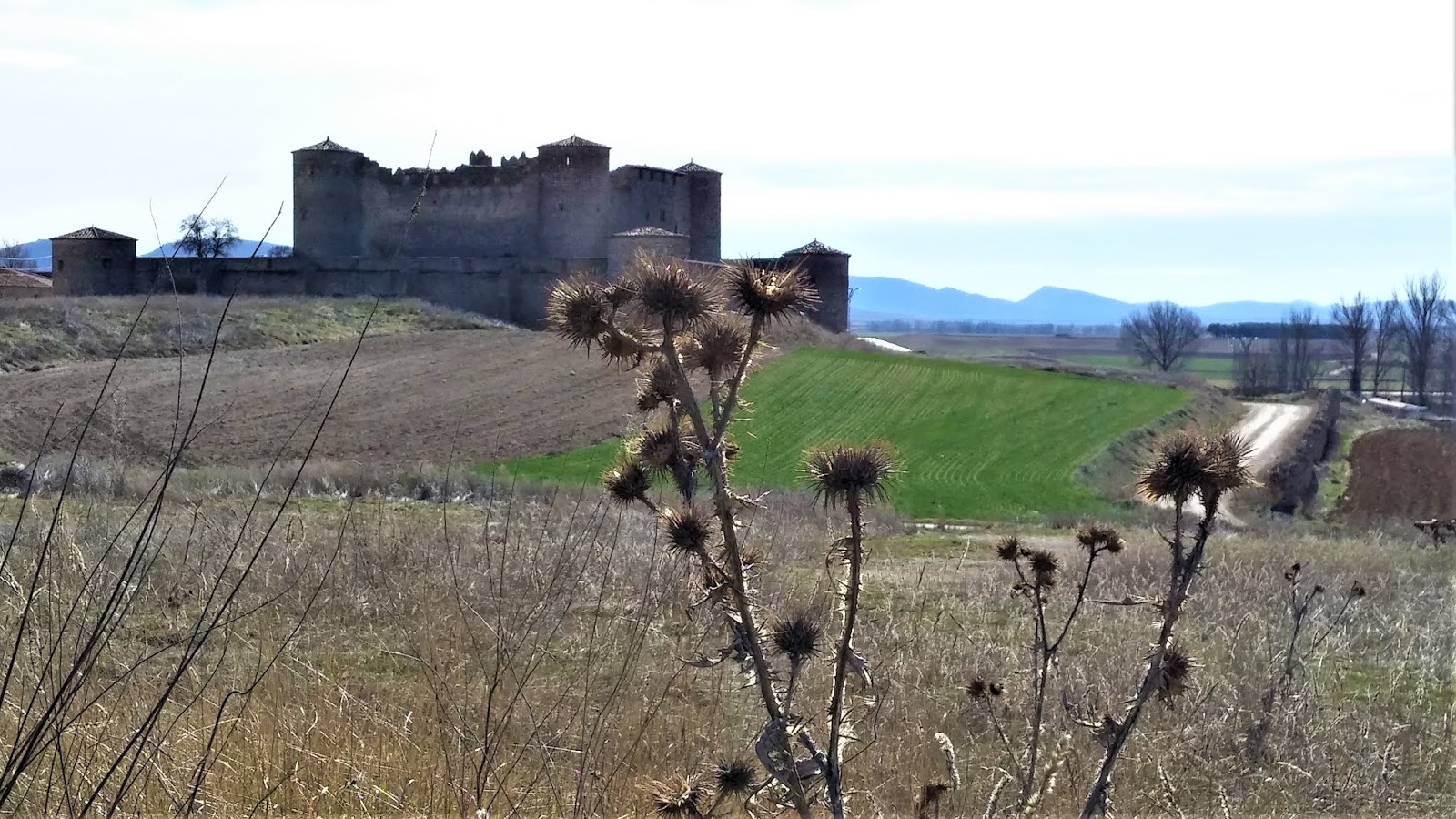
The biggest surprise was the existence of the castle. It shouldn't have been a surprise, since "Almenar" refers to a battlement or watchtower, but there it was, with its own history. I regret that we couldn't find anyone to open the castle up to us, because from there, the views of the valley would have been the most impressive.

Some sources say the oldest parts of the castle are contemporary with my characters, the tenth century. This would be parts of the homage tower or keep, which we couldn't get close enough to inspect. If there was a castle in the tenth century, then the seven noble knights would've seen the Moorish troops coming at them from around it.

Most of the castle as seen today was built in the fifteenth and sixteenth centuries and belonged to the Counts of Gómara. Carlos II and Felipe V were in residence at certain times. This castle also inspired some of the legends written by the famous Romantic poet, Gustavo Adolfo Bécquer, and it's said he lived and wrote there. (It looks like a pretty good writers' retreat to me.) There was a sign on the door we could barely make out that said something about the modernist poet Antonio Machado and his young wife, Leonor Izquierdo, staying there, as well, and I later read that Leonor was born in Almenar.

Photo 2019 Daniel Sanz 
The well-preserved castle is now privately owned.

The town of Almenar comes right up to the castle. 
Hermitage of the Virgin of La Llana,
eighteenth century. 

I'm glad the castle looms over the bucolic landscape today. The contrast between the peaceful fields and the manifestation of military power in stone reminds us of the battles, but also what so many were fighting for.

* * * 
The moment the brothers appeared once again at the entrance of the tent, the drummers gave a terrifying crash and the Moorish knights fell on them, surefooted even on the undulating slope. Gonzalo gripped his sword as his only lifeline and thrust outward, cutting and swiping at whatever he could. The Moors in charge of moving the dead and wounded took away a hundred soldiers within two hours. Gonzalo fought on two fronts: the fear rising from his darkest heart had to be beaten back at every turn, and the neverending troops had to be cut down. 

. . . and still the soldiers kept coming, with fresh horses and undamaged shields. Their prey could hardly move enough to control their own hands, and most of them had broken their shields in half and lost either their swords or their close-range daggers. 
* * * 

All excerpts from Part One, Chapter VIIII of Seven Noble Knights. 

More adventures in Soria are available at my Facebook page (March 2019), but I've saved the best parts for future posts here!