As I mentioned in the previous post, I joined a writers group shortly after my arrival in Spain. The first meeting made me feel incredibly welcome. During the second meeting, we analyzed some of the poetic works of surrealist Rafael Alberti.
I love surrealism, but I'm not sure I could ever write it well. So I'll do the next best thing and translate one of the poems. When you think about the images, they become less surreal. They point to whatever reality you're living at the time you read them.
The Dead Angels
Look, look for them:
in the sleeplessness of forgotten pipework,
in the courses of rivers interrupted by the silence of garbage.
Not far from the puddles unable to hold a cloud,
some lost eyes,
a broken piece of jewelry,
or a star that's been stepped on.
Because I've seen them:
in the momentary debris that appears in the mist.
Because I've touched them
in the exile of a deceased brick,
come to nothing from a tower or a cart.
Never farther than the chimneys that fall to pieces
nor those tenacious leaves that get stuck to the bottom of a shoe.
In all this.
Even more in those vagabond wood chips that get consumed without fire,
in those sunken silences suffered by dilapidated furniture,
not far from the names and signs that grow cold on the walls.
Look, look for them:
under the drop of wax that buries the sense of a book
or the signature in the corners of a letter,
which it comes stirring up dust.
Near a lost bottle cap,
a shoe sole gone missing in the snow,
a shaving razor abandoned at the edge of a precipice.
Alberti wrote this poem during a crisis of faith. Everything they'd taught him about God, angels, heaven, hell... he just didn't buy it anymore. This is an unpleasant thing to have happen to you, but if you make it through, it can lead to more and better art in the future.
Here Alberti sees dead angels (lost innocence, our better natures, or faith) in things rotten, dead, or forgotten. He sees a world full of useless, cynical items, and not a single chance at redemption.
It's a pretty good description of someone going through deep, comsuming grief. None of it is pleasant. Without unpleasantness, would we appreciate the good around us?
It's been therapeutic to translate these images and I hope it's been therapeutic to read and think about them. Thanks for reading! With this out of the way, there's plenty of room for fun stuff in the weeks to come.

Showing posts with label poetry. Show all posts
Showing posts with label poetry. Show all posts
Monday, October 16, 2017


Monday, April 20, 2015
Great Writers of New England: Emily Dickinson

 |
| Mr Higginson, Are you too deeply occupied to say if my verse is alive? |


The tour at the beautiful home (at the top of the post) where Emily was born and died emphasized her passionate, gregarious nature. Her hair remained bright red until her death, as if reflecting the emotion we see in her writing. Her family was important in Amherst and Emily was well educated and had many friends. But the fact remains that as her life went on, she became more and more reclusive. Emily died at 55, and high blood pressure seems to have been the culprit. High blood pressure and reclusiveness suggest that she suffered a lot of anxiety.
On the other hand, when you enter her bedroom, you can see why she wouldn't have wanted to leave. It was on the second floor in the corner visible in the photo above, and she had great views:
 |
| She could see her brother's house next door... |
 |
| ...the building where her father worked in town... |
 |
| ...and this church's steeple. |

I say "determined" because she kept writing in spite of what appears to be a deeply held belief that her writing was of no interest beyond Emily's circle of friends. In other matters, she doesn't seem to have been someone so easily kept down. So why didn't she try harder to be published? (Ten poems appeared anonymously during her lifetime.) It must be partly due to her respect for Mr. Higginson's opinion. The two corresponded throughout Emily's life. He visited Amherst a couple of times and spoke at her funeral. And so, in spite of numerous accomplishments, Mr. Higginson is mostly remembered as the man who told Emily Dickinson not to publish.
Lack of publishing deadlines freed Emily up to keep perfecting her poems for years. She was very particular about word choice, which is admirable, but has made the editing of her work nightmarish.


Much more information about Emily Dickinson's surprisingly complex life and the inspiring place she lived and worked is available at the museum's site.
Monday, March 23, 2015
Great Writers of New England: Robert Frost
 |
| Robert Frost as gourd at the Jack-o-Lantern Spectacular at Roger Williams Park in Providence, RI, 2014 |
 |
| The farmhouse |
 |
| The barn/visitor center |
 |
| Inside the farmhouse. Let the words pour out! |
The beautifully maintained farmhouse is attached to a barn, where you can learn about Frost's family, his work, his fans, and many curious farm implements.
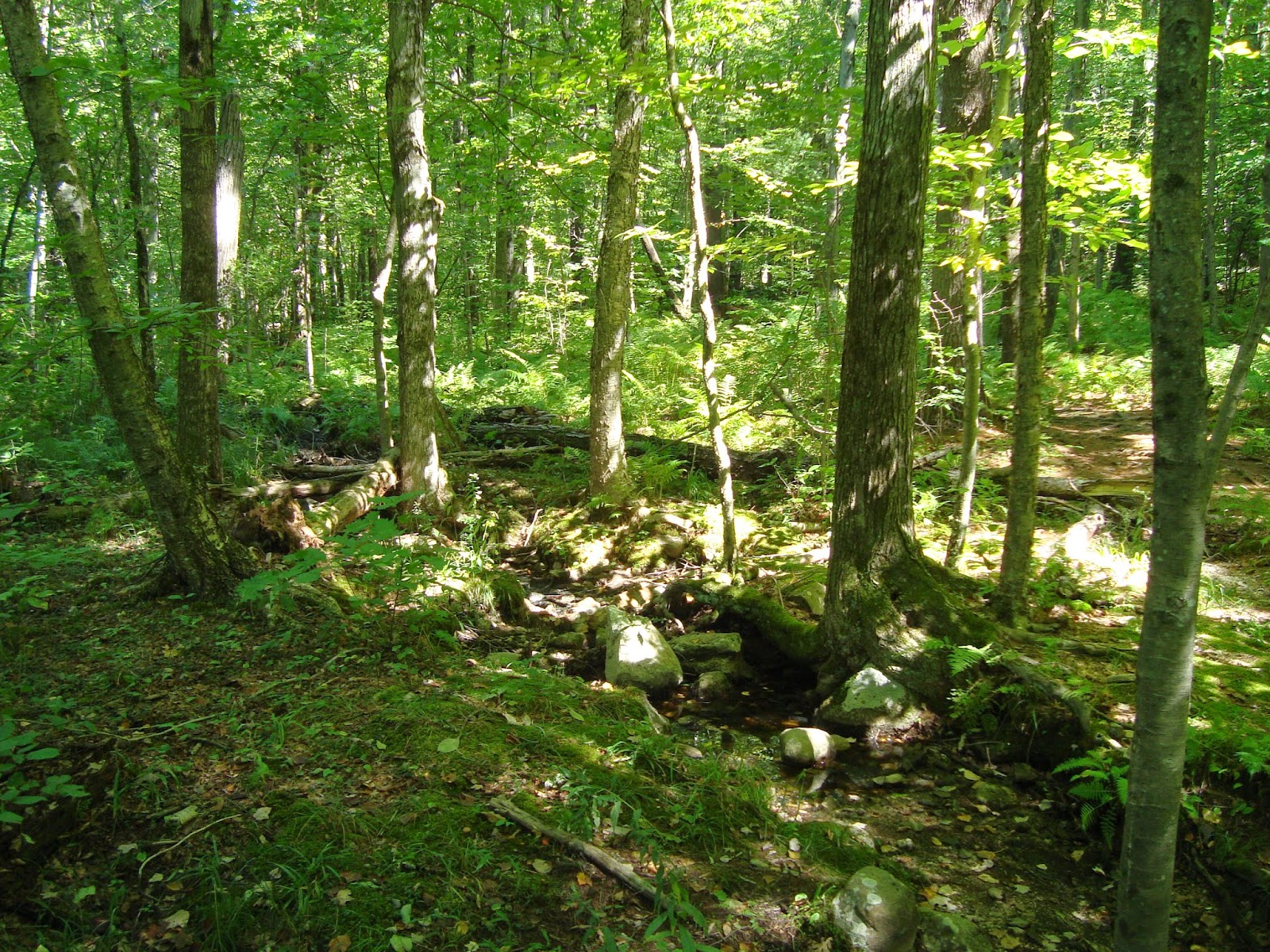 |
| Whose woods these are I think I know... |
Outside, a deep meadow leads into woods that look much the same as they must have in the first decade of the twentieth century, the way Frost would have seen them. You can take a photocopied trail guide or wander at your leisure.

The Frost farm, as well as welcoming poetic pilgrims from all over, hosts regular readings and events, and even holds a poetry contest. The simple presentation allows unencumbered access to why New England is a great place to be a writer.
A lot of Frost's work is now available online. Learn more about the farm today, too!
All photos in this post taken and © 2014 by Jessica Knauss
Wednesday, February 6, 2013
The Wanderers
The Wanderers by Manolo García (from Los días intactos, 2011)
I am my own inner slave
who staunches his wounds by biting his fists.
I am a previous stranger,
a tightrope walker who unleashes false skies.
And today
when this uncontrolled fire devastates all thought,
today, when I am a prisoner of my desires,
I’m far from wanting to be the stoic I once was.
There will be a place for the wanderers,
there will be time to wander.
Today I think about the song of the emigrant,
of the residual tourist.
Now that the pumping of my blood
is getting strangely discouraged,
today I think about the song of the emigrant,
of the trapped people who struggle in their exile,
of the people who run.
A city full of amazed people,
that would be me, asking for help.
Asking for help, with an outstretched hand,
looking for plenitude, that elusive animal.
A rudimentary destination of bone and orange light,
that would be me. A pitcher in space who needs
clamps and roots is who I would be today.
And
today, when an uncontrolled fire
devastates
all thought,
today,
when I’m a prisoner and desire you,
I’m far from wanting to be the stoic I once was.
There will be a place for the wanderers,
there will be time to wander.
Today I think about the song of the emigrant,
of
the emotional traveler.
Now,
when I’m grounded and a dilettante,
the
planking is curving,
today,
I think about the song of the emigrant.
Of
infuriated people in search of wonders,
of
the people who run.
And it’s not
about love or misunderstandings.
Not about lost
years.
Not even longing
for the brilliance inherent in life.
Today only I
want to win this round against impatience
and the apathy
that brings a desolate grimace.
Wednesday, November 28, 2012
A Poetic Present
Out of nowhere -- and this is especially surprising because it has to do with a poetry book, and I thought no one reads poetry anymore -- Dusk Before Dawn got this stellar, utterly unsolicited review.

It sure makes me feel appreciated as a writer. It's about the best holiday gift I could get, as I come out of the dark cave in which I've been furiously writing all month.
So, as a reminder, that's the second surprisingly positive review for Dusk Before Dawn, the other being on Goodreads here.
 Find it at:
Amazon
Nook
Kobo

It sure makes me feel appreciated as a writer. It's about the best holiday gift I could get, as I come out of the dark cave in which I've been furiously writing all month.
So, as a reminder, that's the second surprisingly positive review for Dusk Before Dawn, the other being on Goodreads here.

Amazon
Nook
Kobo
Friday, May 18, 2012
New Review of Dusk Before Dawn!
Dusk Before Dawn was a wonderful short collection of poetry. In this collection Jessica Knauss cleverly divides the the poems into sections based on five senses, allowing you to experience each section with a different sense. The Spanish influence in the poems and the almost seamless melding of the Spanish language into many of the works seemed to draw a connection between the reader, the author's thoughts and the struggles and triumphs of Spanish culture. Through these poems I not only felt a connection to the Moors as they were expelled by a new regime, I also felt a connection to everything that makes Spain what it is. I felt a yearning to jump on the first plane and head to Cordoba or Barcelona. However, despite my love for the Spanish language I was shocked that so much of the book was in Spanish, and if I was not a Spanish student I fear much of this delicious poetry would have been lost on me. When I began this book I was not persuaded by the first poem, or the second, but Knauss quickly ensnared me in her trap with the third poem, the fourth poem and many others after. I hope to see more of her work in the future!
Thanks so much! You make me feel like a real poet!
Friday, March 23, 2012
Goodreads Giveaways!
I have two exciting giveaways on Goodreads right now! They both end on April 27, so get your names in the hat!


Monday, October 3, 2011
Discontinued Journals

This Mutant Life, which had made my dearest wish come true in September 2010 by publishing my first rhinoceros story, "Rhinoceros Dreams," is gone without a trace, with no warning or communications in that regard.
On the other hand, The Shine Journal's editor wrote a nice farewell message earlier this year, explaining the end of the magazine without overjustifying. In contrast to other sites that simply shut down, this little goodbye was reassuring. It appears that the site will remain active for some time, so my poem is still available here.
The best news is that none of the other journals seem threatened. They're all flourishing, which is gratifying and shows that literary journals are a great use of the internet.
I'm still deciding what to do with "Rhinoceros Dreams." How can they best run wild: in a journal that takes reprints, in a collection, or just roaming my imagination?
Thursday, May 26, 2011
New Format For My Poetry Book
After much nose to the grindstone, I'm happy to announce that the digital version of my poetry volume, Dusk Before Dawn, is looking much better than it did before. It contains all the previously published items listed in the Good Reading page (except "Real") as well as many many gems unavailable elsewhere.
It will be available in Kindle shortly, and is already up for Nook. Enjoy!
It will be available in Kindle shortly, and is already up for Nook. Enjoy!
Sunday, May 8, 2011
Happy Six Sentence Mother's Day!

Many thanks to everyone who left comments last week! I appreciate it so much! Here's the hub of activity.
In honor of Mother's Day today, I asked my beautiful mother to choose her favorite thing I'd ever written, and I would select six sentences from that. I was surprised that she selected a poem of mine from my long-forgotten poetry volume, Dusk Before Dawn. The poem is based on the painting pictured above, which hangs in the Museum of Fine Arts, Boston. Poetry seems a bit unorthodox for Six Sentence Sunday, but I don't see anything that prohibits it, so, here's to you, Mum!
The Painter’s Honeymoon
Lord Frederick Leighton understood
that loves comes in soft hues of gold;
that its lines are warm and comforting,
smooth and flowing as the folds of an olive-toned gown
which, with its velvet, covers layers of full, bountiful petticoats,
completely hidden.
He recognized that love blooms like golden pears outside the window,
blossoms like the glow in the young bride’s face.
As he tenderly holds his sketching pencil,
so too does he hold her hand
as she inclines toward his smooth face,
her eyes lowered.
The wide drawing desk shades and obscures
the red passion of his stockings.
Affordable and lovely, Dusk Before Dawn is available from Amazon and by request at most independent booksellers and libraries. Mothers agree, it's great!
Monday, April 25, 2011
Poetry for Mother Earth
I missed April 22 because we had a literarily great anniversary to celebrate, but I would like to nod to my favorite Spanish poet, Manolo García, and present his "Sabrás que andar es un sencillo vaivén" with my humble interpretation in English to start off Translation Week. Here, García's love for nature comes through loud and clear.
Being born, living, faces full of longing,
with expressions eager for life.
I see it in the streets,
in stopped time.
We’re all living, growing, exposed to love.
Exposed to crying, to nostalgia,
to laughter and to pain.
Willing for every moment
that we love life.
Living to love,
a blowing breeze. Life.
Any form of life
in the pitched battle
in a world that will sink
if we don’t champion every life form
in nature.
If a paved-over, lifeless world fails to worry me.
I’ll find that walking, feeling,
is a simple rhythm.
And at times, leaving myself behind
will make my baggage lighter.
You’ll find that waking up
to that simple rhythm
is just breathing and letting yourself be carried away
by ducks migrating, by an apple tree
or by the grandiosity of an iceberg.
Being born, living. A sparkle, a detour. Life,
the pull of life.
I see it in people,
in the present time.
Celestial body, love of the campfire.
Exposed to damage, to treachery,
to enjoyment and to forgiveness.
Willing for every moment, hungry for life.
I’ll find that walking, feeling,
is slowing down, stopping.
And at times becoming detached, since in the end
pure air satisfies lungs and anxiety.
I’ll know that waking up
to that simple rhythm
is slow; it’s arriving at serene limits
in a whirl of butterflies, towards a fjord
or in the cobalt blue of a hurricane.
Friday, December 3, 2010
Without Language in Córdoba

The theme of the issue is "Translation," a theme dear to my heart. Interpreted widely, it pertains to people trying to communicate in any way they can, and so encompasses most of human experience.
The poem came to me during a study abroad experience in Córdoba, Spain. As we realized more every day after we got there, Córdoba was the original melting pot. In spite of the discomforts it implied, the blending of peoples, languages and cultures created an experience so astoundingly beautiful, it can still be felt today in the air that passes through.
My room mate (and best friend) was having a tough time. She loved Spain (I like to think I had something to do with that) but October is always emotionally raw for her. One day she just got up and went for a walk while it was still dark outside, and contemplated the serenity of the Roman Bridge in the early morning light. By the time I woke up, she was back and telling me about the adventures she'd had. Anywhere else, they might have been commonplace, but the setting made them almost mystical.

In workshop, the other members were sorely disappointed to hear that I wasn't writing about something that happened to me personally. I think one of them claimed she would continue pretending. That's absolutely fine. I don't think the poem is injured, no matter who the subject is. What is imagination for if not to bring vivid experiences to people who never had them?
Take a look at the poem here. I'll also add the link to my "famous publications" page.
"Without Language in Córdoba" is one of the centerpieces of my collection Dusk Before Dawn.

Monday, November 1, 2010
"Real"ly Published in Cave Scribbles
My poem "Real" has made it into the genial Cave Scribbles, a journal that explores the human condition through words. Read the whole thing here. The link is also in the "Good Reading" page to the left.
I was inspired to write "Real" as a response to the vertiginous vacuum left after my boyfriend would visit me at college during Spring Break. As I've mentioned in another post, this was my first love, and I was madly and deeply attached to him. We went to college 3,000 miles apart, and our Spring Break schedules were skewed: his was the week before mine. Since I was the poorer of the two and couldn't fathom another plane ticket, he came to visit me, staying in the dorm common rooms or the bed-and-breakfast, witnessing me and my friends as we went to classes, sometimes took midterms, and prepared for our Spring Break. It was unreal to have him there, that tangible piece of my heart, bringing all his California goodness with him. He fit in surprisingly well, considering that I slept in all-female dorms throughout college, but his presence was somehow on a different plane. He and my college never seemed to be occupying the same space at one time.
The sensation increased when he left and I turned to a week of no classes but plenty of studying. (There wasn't anything else to do, even if I hadn't been a complete nerd.) The entire campus was suddenly imbued with his presence. I thought I could hug him in the hallway, or get him a soda in the dining hall, but he just wasn't there anymore. I began to doubt that he had been anything other than a figment of my imagination. Hence the poem.
I don't think of this darling boy very often any more, but when I do, I get the same sensation that I made him up, a sensation backed up by failed Google searches. Somehow he's managed to remain anonymous in this era of information access. Very strange, indeed.
"Real" doesn't appear in Dusk Before Dawn (although many fine poems do!): Cave Scribbles is the only place you'll get to read it. Like my first boyfriend, it could easily become an evanescent experience, lost to the sands of time. Enjoy!
I was inspired to write "Real" as a response to the vertiginous vacuum left after my boyfriend would visit me at college during Spring Break. As I've mentioned in another post, this was my first love, and I was madly and deeply attached to him. We went to college 3,000 miles apart, and our Spring Break schedules were skewed: his was the week before mine. Since I was the poorer of the two and couldn't fathom another plane ticket, he came to visit me, staying in the dorm common rooms or the bed-and-breakfast, witnessing me and my friends as we went to classes, sometimes took midterms, and prepared for our Spring Break. It was unreal to have him there, that tangible piece of my heart, bringing all his California goodness with him. He fit in surprisingly well, considering that I slept in all-female dorms throughout college, but his presence was somehow on a different plane. He and my college never seemed to be occupying the same space at one time.
The sensation increased when he left and I turned to a week of no classes but plenty of studying. (There wasn't anything else to do, even if I hadn't been a complete nerd.) The entire campus was suddenly imbued with his presence. I thought I could hug him in the hallway, or get him a soda in the dining hall, but he just wasn't there anymore. I began to doubt that he had been anything other than a figment of my imagination. Hence the poem.
I don't think of this darling boy very often any more, but when I do, I get the same sensation that I made him up, a sensation backed up by failed Google searches. Somehow he's managed to remain anonymous in this era of information access. Very strange, indeed.
"Real" doesn't appear in Dusk Before Dawn (although many fine poems do!): Cave Scribbles is the only place you'll get to read it. Like my first boyfriend, it could easily become an evanescent experience, lost to the sands of time. Enjoy!
Tuesday, October 26, 2010
Poetry Corner: Jarchas
In a beautiful corner of the world -- Moorish Andalucía -- in the eleventh and twelfth centuries, poetry was central to civilized existence. Fidelity to established forms and linguistic abstraction were prized above all else.
But these subtle writers in Arabic also enjoyed observing life around them, and that meant sometimes overhearing the songs of the mozarabes, Christians who spoke a now-extinct mixture of Arabic and the local romance language. The poets liked to punctuate their long, stately poems with short, and sometimes mysterious, snippets in the voice of a mozarabe, often a beautiful young woman. These snippets, called jarchas, are the only poetry we have from this linguistic group. Scholars have transliterated the jarchas from the Arabic script in which they're found in order to approximate these lost rhythms and sounds.
Jarcha from moaxaja number 8 of Jehuda ha-Levi (1070-1141):
Non me mordas ya habibi, la
No quero daniyoso
Al-gilala rajisa: basta
A toto me rifyuso
Do not bite me, my friend, no. I don’t want someone who hurts me. The bodice is fragile, stop. I refuse everything.
Linguistically, this jarcha is a special treasure that plays out its social milieu. While the grammar and most of the words are in romance, and recognizably related to modern Spanish, the terms for refined, luxury concepts (lover, bodice, fragile) have been derived from the Arabic.
While it's tempting to see it as a quasi-feminist plea to be treated with respect, we have to take into account the venue in which this jarcha would have been heard: in a predominately male court. The snippet itself is likely written by the poet of the main text, also male. So, the most likely interpretation is a comic relief / lurid one, although we will never know for sure.
While it's tempting to see it as a quasi-feminist plea to be treated with respect, we have to take into account the venue in which this jarcha would have been heard: in a predominately male court. The snippet itself is likely written by the poet of the main text, also male. So, the most likely interpretation is a comic relief / lurid one, although we will never know for sure.
The text, translation, and a lovely version with instruments of the time are presented in the album El Crisol del Tiempo.
Also note the changes to the site: you now have access to a list of my publications, with links to excerpts and full texts, on a separate page, linked on the left of the screen. The enjoyably watchable videos are listed on their own page. Enjoy the reorganization! More great content coming soon!
Saturday, October 2, 2010
"Invasion"
My latest publication, a poem entitled "Invasion," is now at Apollo's Lyre for your viewing pleasure! It's sixth in the Table of Contents.
I wrote this gem as a self-portrait assignment. This was how I looked to myself at the time: alone at a desk in the wilds of Massachusetts, contemplating my forever unattainable love, who was at that time in California.
Importantly, "Invasion" is just one of the many great poems on offer in Dusk Before Dawn. Online or in print, enjoy!
I wrote this gem as a self-portrait assignment. This was how I looked to myself at the time: alone at a desk in the wilds of Massachusetts, contemplating my forever unattainable love, who was at that time in California.
Importantly, "Invasion" is just one of the many great poems on offer in Dusk Before Dawn. Online or in print, enjoy!
Friday, September 3, 2010
My New Release: Dusk Before Dawn (Poems)

How do we make poetry? Through the unlikely medium of language.
Why do we write poetry? For love.
Where do we find poetry? In those evocative spaces full of old spirits.
When do we create poetry? Whenever the muse strikes.
For whom did poetry come into being? For each and every human.
Based around these questions, the book offers 28 provocative poems, in English and a smattering of Spanish, especially for your enjoyment.
You were waiting for it, even if you weren't quite aware what you were waiting for. My book of poems, Dusk Before Dawn, is now available!
Dusk Before Dawn unites all my favorite poetic work from over the years. Some you will find good, some bad, some short, some long: an infinite variety. Hopefully, it's all entertaining. The book includes the tour de force "Call Numbers of the Wild," recently published in Haggard & Halloo, and also four others slated to appear in various 'zines. Have all your favorites in one place, to have and to hold, to read again and again!
It might be a few more days before it loads into Amazon.com and Amazon.co.uk, but please buy it here and I will get more royalties. Please buy it for your friends, buy it for your enemies, buy it to help the starving author who put it together, buy it to laugh at said author, but please, just buy it. At $6.99, it won't break the bank, but your purchase will have a huge impact on the life of this humble writer. And please tell your friends to buy it, and tell that guy from accounting to buy it. Tell a librarian to buy it for her or his library.
Thank you so much. I appreciate it. I will sign it with a personalized dedication if we ever cross paths.
Again, please take a look and buy it HERE. Thank you.
Friday, August 27, 2010
"Call Numbers of the Wild" Read by the Author
"Call Numbers of the Wild" was first published in Haggard & Halloo August 17, 2010. (You can still find it there and comment! See my publications, below.) The link is to my amazing YouTube performance of it. Enjoy!
I wrote this poem in response to the dizzying sense of vertigo I would feel when assigned to reshelving on my library shift at my alma mater, Wheaton College (Massachusetts, people, not Illinois). If you look around on the site a little, I'm sure you can find a picture of the pond in the poem. (It's much smaller than its psychological impact would have one believe.) Most of the stacks at the main library are underground, some underneath the science building, some abutting it, leaving tantalizing locked doorways in the farthest reaches. Sometimes the librarians would actually take book trucks outside and through the science building in order to get to an elevator that was closer to that far back area, and magically unlock the doors to gain access to where they really needed to be. While not circular, that library was dark and made of concrete and easily lent itself to interpretations of infinity a la "The Library of Babel" by Jorge Luis Borges. So I dedicate this poem to the spirit of librarians everywhere. Order in the chaos!
I wrote this poem in response to the dizzying sense of vertigo I would feel when assigned to reshelving on my library shift at my alma mater, Wheaton College (Massachusetts, people, not Illinois). If you look around on the site a little, I'm sure you can find a picture of the pond in the poem. (It's much smaller than its psychological impact would have one believe.) Most of the stacks at the main library are underground, some underneath the science building, some abutting it, leaving tantalizing locked doorways in the farthest reaches. Sometimes the librarians would actually take book trucks outside and through the science building in order to get to an elevator that was closer to that far back area, and magically unlock the doors to gain access to where they really needed to be. While not circular, that library was dark and made of concrete and easily lent itself to interpretations of infinity a la "The Library of Babel" by Jorge Luis Borges. So I dedicate this poem to the spirit of librarians everywhere. Order in the chaos!
Subscribe to:
Posts (Atom)