Subscribe to Jessica's exclusive newsletter

Subscribe to Jessica's newsletter

* indicates required

Thursday, May 9, 2019

Puebla de Sanabria: Untouched by Time

Puebla de Sanabria on its rocky outcrop over the Tera
juts into the tourist's imagination.
Photos in this post 2018 and 2019 Jessica Knauss 
It was the winter low season in Puebla de Sanabria, with no festivals or pilgrimages scheduled for months, but my traveling companion, Daniel, felt lucky to grab the last available one-star hotel room in the historical center. Puebla is one of the official Most Beautiful Villages in Spain, a France-inspired list that began in 2011 as a way to promote rural tourism. It’s working.

Still can't get inside.
Photo 2019 Daniel Sanz 
We’d come to see Romanesque buildings, but quickly found that the churches on my bucket list were closed for visits until Easter week. We were left with buying souvenirs or walking among the pristine streets to admire the popular architecture.

It wasn’t a bad consolation prize, because aside from the occasional car and a dragon-faced rainspout the residents couldn’t resist, the old town of Puebla looks as it must have in the sixteenth or seventeenth century. Tawny stones fit together in pleasant haphazard puzzles, noble crests adorn palaces, and extended eaves and colonnades provide shelter from wet weather. We aren’t the only visitors to get the sense that this is a place untouched by time.

The view from the castle 
After the climb to the robust, legend-filled castle at the top of Puebla’s dramatic rocky outcrop, we stood at the gusty vista point to gaze down at the river and newer part of town below. We read a plaque that advocates a tenuous connection between this place and Miguel de Cervantes, then headed west on streets lustrous with slate paving beneath balconies made of hand-carved wood.

It wasn’t long before we arrived at the other side of the rock, a parapet facing a green valley and the setting sun. A line of yet more historical homes cozied up to the bottom of the rock, but one caught our attention because the roof, near our eye level, was a timber grid, and stacks of slate tiles awaited placement.

Slate roof 
“They’re really doing that up right,” said Daniel. “It’ll fit in with the other houses, and it’ll last forever.”

New "old" construction. 
A cat darted across the parapet, shooed by a woman in house slippers and a T-shirt farther down the street. “Sorry,” she said as we approached. “The cats get into my plants!”

Pots and vases covered the parapet in front of her house, which she said they’d built in the 80s with high hopes. “It’s really big,” she said. “It’s only this wide, but goes way back, and it has two stories and the attic, which we were allowed to build because the house that was here before had one.”

“This was only built in the 80s? It looks much more historical,” said Daniel.

“The city makes us use traditional materials. See, the window frames are wooden. The sun batters the façade in the summer—it gets to be 40 degrees Celsius right here.” I believed her. At sunset in February, my jacket already felt heavy. “And in the winter, the frost comes and splits the wood, no matter how hard it is.”

“They make PVC that looks a lot like wood now,” said Daniel.

“I wish I could use PVC, but the city won’t let me. It has to be authentic for the tourists.”

Black mascara that must’ve once matched her hair color ran down her cheeks in the tracks of old tears. Her husband had passed away five years before. The children had all moved away, one as far as Valencia. They encouraged their mother to convert the grand family inheritance into a hotel, like many of the other homes in the old town. Otherwise, it was headed for neglect and ruin, with no one there to care for it. It looked as if the woman wanted to tell us she would live forever to personally take care of this legacy.

When we said our goodbyes and moved on, I spied the shadow of someone waiting for the woman at the end of the hall. A sister or cousin, as bent by time as she, hadn’t made it into her loneliness narrative. But I was relieved she had some company in her battle against the two fronts of history and progress. Puebla de Sanabria is touched by time, after all.

Monday, April 29, 2019

Visigoths in Palencia! San Juan de Baños

San Juan de Baños
All photos in this post 2019 Jessica Knauss 
It might cheapen the effect to give you the money shot of this lovely historical building right at the top of the post. In reality, it's not something a casual traveler stumbles upon. Like most Visigothic monuments, San Juan de Baños is in a tiny locality not known for any other reason. I had to randomly hear about this, the only Visigothic church with a firm date, figure out where the heck Baños de Cerrato is, and then wait until I found a friend as crazy as I am about historical-themed road trips to take me there. Overall, there is a high risk of spending your time in the unique, fascinating small city of Palencia, never knowing what you missed.

San Juan de Baños has the feeling of being nowhere,
but it's right next to an industrial area.  
This church is in this location for a specific reason. In January 661, King Reccesvinthus was returning to Toledo from fighting rebellious Basque tribes in the north and feeling rather poorly, as you well might in the early Middle Ages. The cortege stopped in Balneos (now Baños de Cerrato) because someone had heard of the curative waters there. It had been a spa town since Roman times. Reccesvinthus drank the water and felt much better. This miracle inspired him to found a water/baptism-themed church in that very spot.

The original dedication stone is up high and decorated with sunbursts. 
The church still proudly displays the stone on which Reccesvinthus inscribed his dedication of the church:

A replica of the dedication stone is set where visitors can read it. 
"The precursor of the Lord, the martyr Saint John the Baptist, owns this house, built as an eternal gift that I, King Reccesvinthus, devout worshiper of your name, dedicated to you, by my own right, in the third year after the tenth as illustrious companion of this kingdom. In the year 661."

Water quality is not guaranteed. That didn't stop my friend! 
The fountain has fallen into disrepair and been rebuilt many times since Reccesvinthus's time, but the spring water has never stopped flowing. The latest reconstruction is from the 1940s, with two horseshoe arches that echo the architecture of the church.

Most of the stones here and especially the horseshoe arch
were put together in 661! 
The building itself is in a remarkable state of conservation. The bell gable was added in 1865. Apart from that, the only extant features that are not from 661 are the roof, the jalousies (lacy stone window panes that must be modeled on pre-Romanesque buildings I adore in Oviedo), and the floor.

The geometric floral friezes in the door will be echoed inside. 

Archaeologists took advantage of the rehabilitation of the floor to dig around and find many wonderful items that are now housed in the Museum of Palencia, such as Visigothic burials and a curious tile. It showed up in the excavations with an imperious hand print, giving rise to the legend that it was Reccesvinthus's way of signing the church he ordered to be built. Whosoever possesseth a hand that fitteth into the impression exactly shall be named new King of the Visigoths. As you can see, my friend is now King Daniel of the Visigoths. I tried too, but my pinkie was too short. The page pictured next to the replica says only that a perfect fit will give the hand's owner good luck. I guess they're not ready to hand the crown over, even though the kingdom no longer exists!

The main altar. The wooden roof is made to
look as it might have in Visigothic times. 
When you enter, the space is not large, but the simple lines of construction produce a sense of vastness. Horseshoe arches dominate the scene, proving that the Iberian Peninsula did not have to wait until the Arabs and Berbers took over in order to grace its buildings with this pleasing shape. We see them in the grand arch of the main altar, the windows, and between eight columns.

The guide says the lateral arches are slightly irregular, but you would really have to look to spot the flaws. The impression is of stately harmony.

The marble columns have been harvested from Roman villas that have long since disappeared. Most if not all the stones used in the rest of the church are also likely recycled from Roman buildings. In this way, the Roman legacy has come down to us today, only slightly altered.

The recycled Roman capital is right next to the main altar. 
One Corinthian column capital has been identified as a late Roman carving based solely on its style.

The other capitals are also Corinthian style, but the execution is less ornate. The guide seemed to think the Visigothic artisans were unable to produce the same level of detail as their direct Roman forebears. Having studied the purposeful simplicity of Romanesque art as contrasted with the complexities of the Gothic area, I appreciate the clean lines of the Visigothic capitals and believe the differences between them and the Roman one are due to taste.

I especially like this capital because the interpretation of the Corinthian pattern is so free, and because the diminutive four-petaled flower in the center inserts the new Christian symbolism into an ancient context.

Lest we think the ancient and medieval world was all bare stone, the guide was careful to point out the paint traces. Medieval people did not want to look at their construction materials in their finished edifices any more than we would want to stare at rebar or insulation. They filled their buildings with color and shapes! Here you can also appreciate the geometric flower friezes, repeated throughout the building, inside and out. Interest, focal points, horror vacui, it's all here, in this seemingly simple space.

In keeping with the baptism theme, San Juan de Baños boasts an ancient baptismal font, exactly the kind of thing I imagine Mudarra using in Seven Noble Knights. The lack of decoration makes it hard to date, but the guide said the best guess places it between the fifth and sixth centuries. Adults would have stripped down and stepped right in to be initiated into the Christian church.

A replica of Reccesvinthus's votive crown is hanging in the space it was probably meant for. I've seen the original at the National Archaeological Museum in Madrid and admired the fine metalwork and precious jewels. The sight of the replica in situ moved me deeply.

San Juan de Baños is consecrated, but is only used for visits like this and for weddings. It would be an exceptionally elegant place to say vows, in my humble opinion.

The foot of the church with the door
and the guide's station.

Palencia is the host of one more of these rare pieces of Visigothic architecture, and it has another legend attached to its founding, so check this space for more!


Saturday, April 27, 2019

Zamora's Medieval Treasures: Holy Week 2019

Tuesday night of Holy Week
Jessica Knauss 2019 
I honestly thought that, this being my second Holy Week in Zamora, I could maintain a more distanced perspective on this apotheosis of folklore, popular religion, and art. I figured I'd pick up the processions I missed last year and the week would be mostly normal, a proper rest during which I could probably get some writing done.

How quickly we forget!

Last year, I had to skip the Friday of Sorrows procession of the Penitential Brotherhood of the Most Holy Christ of the Holy Spirit because the weather was terrible. Being the first late-night procession, I didn't know what I was missing and so didn't have the wherewithal to trek across Zamora in the nighttime wind and rain. This year, I arrived early enough to catch the perfect spot at the iron fence around the cathedral atrium, early enough to watch several TV crews setting up. And still I thought it would be no big deal.

The cathedral plaza filled with enthusiasts, and the air became thick with expectancy. The choir assembled in the atrium, and one of the choristers even came out to the fence where I was to chat with his girlfriend. And then the first brotherhood members appeared in their white monklike hoods with  the first "float" an intensely heavy bell that rang loud enough to imbue everything with medieval-tinged magic.

Holy Week magic was back!


I couldn't miss anything from then on. I saw every procession I missed last year and tried to revisit old favorites to a memorable, soggy conclusion. I saw colors, smelled incense, and above all, heard amazing music.


I'd booked a trip to Palencia when I was still thinking I would be more blasé about Zamoran Holy Week, and managed to catch a procession there, too. Amazing to compare to two cities' Holy Saurday traditions.


The trip to Palencia was well worth it, and you will see some gems from that medieval province on this blog.

I've now seen every single one of the processions already (some of them twice), so trust me, there's no way I'll lose my head over the magic of Holy Week again. (Hmmm...)

To round out your experience of Holy Week in Zamora, visit last year's post and last year's anticipatory post. 

Tuesday, April 2, 2019

Romanesque with a Twist: Almazán, Soria

Twelfth-century San Miguel in Almazán
All photos in this post 2019 Jessica Knauss 
I'd been too satisfied with our visit to Almenar to think about much else, but Daniel said, "We have to visit Almazán. Trust me." He was using a guidebook to the "best" Romanesque sites in Spain, and it was turning out to be highly reliable, and really, I'm content with any vaguely medieval site you can show me, so of course I didn't object.

What are some good adjectives for Almazán? Twisted. Skewed. Awry. Catawumpus. Cockeyed.

How so? The above photo is the plaza where we parked. Notice anything unusual?

But let's allow the Romanesque Church of San Miguel to fully illustrate this idea.

San Miguel is in the enormous Plaza Mayor, where the Palace of the Counts of Altamira serves as the tourism office. There you buy your ticket for the church tour. We had many other wonders on our itinerary that day, so we hesitated. I'm so glad we stayed.

San Miguel is right up against the medieval town wall. 
This National Monument was started in the twelfth century. It's fundamentally a Cistercian structure, but the external decoration of the apse has Lombardic-Catalan influence. The lantern is octagonal, using the Romanesque number symbolism for resurrection and suggesting that this church was important in burial rites. Its brickwork screams Mudejar style, and when we go inside, we see that style persists in the dome underneath it. The stones and bricks are laid with the exacting care typical of Romanesque perfectionism.

So when Daniel said we had to see this church because its floor plan is uniquely crooked--couldn't I see it?--I was gobsmacked. No, I couldn't see it, no matter how many photos I snapped. Examining them now, I notice the evidence. Above, for example, the semicircular apse doesn't have a 90-degree angle on either side where it meets the transept. You can kind of see how it doesn't line up with the lantern tower.

More clues are found in this close-up of the apse from the inside. Notice how the pew benches line up with the transept and end up at a wonky angle from the main altar. The crucifix hangs exactly between the sides of the archway, but fails to hang directly in front of the central window. The outermost and inner arches themselves (lightly pointed in Cistercian style) are off kilter.

It's even easier to see in this horizontal photo, considering that I'm standing square with the transept--insofar as that's possible. 

This archway on the left of the apse, close to number 8 on the floor plan below, ended up ridiculously compressed while its mate on the right gives a good pretense of being normal.

In this shot of the same arch seen from below, I dare you to find something--anything!--that lines up properly.

The tour guide rightly spent a lot of time pointing out the features of the magnificent dome. Eight slim arches cross to form an octagonal opening at the top. This is already a great architectural feat, but because we're in Almazán, it has the uniqueness of making the stone look like taffy that's been given a good pull.

I stared up at the dome, but got overwhelmed... by its immense beauty.

We weren't allowed to take photos of any of the very fine painted Gothic and Baroque figures in the church, but luckily, this altar frontal is in bare stone. Although badly worn away or perhaps mutilated, the carving that remains is exquisite. It's a depiction of the martyrdom of Thomas à Becket. This English saint was killed (by a large number of knights, in this depiction) in front of the altar inside Canterbury Cathedral in 1170.

Most of the column capitals are Cistercian plant patterns, but a few were lovely, if high-up, allegories of uncertain interpretation. Here, for example, we have a man on the corner gripping birds by the neck. Birds usually represent the human soul, but it's hard to tell whether they're being saved or dragged down in this case. If anyone has seen this capital closer up and knows of a detail that reveals its intention, please let me know!

Almazán's quirkiness is probably best illustrated by the floor plan:

Floor plan from the pamphlet,
produced by the Most Excellent City Government of Almazán
A lady on the tour had been sitting in one of the pews. When she stood up, she said it made her dizzy! I was trying not to walk or turn around too fast, myself, but I got overexcited, anyway (as I'm prone to do in such places), and felt the seasickness effect for a second. It made me wonder, as everyone else on the tour already had, why the church had been purposefully constructed in such an unusual manner. Did they want to make themselves dizzy with devotion? 

The tour guide insisted we'll never know the answer. One idea is that a few Romanesque churches took the symbolism of their floor plans a long way: figuring that the transept represents the arms of Jesus's cross, the apse must represent the head. The apse is, indeed, considered the holiest part of any Western Catholic medieval church. Since Jesus's head is tilted in most crucifixions, some ingenious architects tilted their apses. But this cannot be the case here, because Jesus's head always tilts toward his right, and if you consider the floor plan, this apse tilts toward his left. Additionally, the apse tilt is only the most obvious part of the twisting nature of this church.

This ivy-covered building is the Santa Teresa Chapel, which makes up the left side of the transept, number 7 in the floor plan above. Here we see the drop-off that starts right at the edge of church and the town wall. The church was a major component in the city's fortification. Perhaps the builders needed to follow the line of the cliff so the defense wouldn't be interrupted with weak points where enemies could gain their footing. Of course, that begs the question, again, why would they want to follow the landscape so literally with the entire building? Why not make only one side curvy? Why not continue the wall along the cliff and bring the church in a little way so it could be a regular, straight, tidy Cistercian Romanesque beacon? 

I fancy someone wrote down the extensive debates that took place over this issue in the public forum, and one day, someone will find that record. In the meantime, it could be a fun plot point in a historical novel... 


Saturday, March 30, 2019

Fertile Fields, Fields of Blood: Medieval Soria

Almenar de Soria
All photos in this post 2019 Jessica Knauss unless otherwise credited. 

* * * 
Young Gonzalo sat astride his mount on the valley crest with his brothers, his tutor, his uncle, and both companies of troops behind him. The valley of Almenar opened out green beneath them, fragrant as the morning sunlight warmed the dewy grasses. A hundred head of cattle grazed lazily, surrounded by droves of bleating sheep, their shepherd perhaps resting, hidden among the brush. Young Gonzalo heard the animals' calls beckoning him. 

"It's everything our uncle promised." A jackrabbit bounded between his horse's legs. 
* * * 

The fields at Almenar 
Part One, Chapter VIIII of Seven Noble Knights is one of the most challenging passages I've ever written. Not only did I have to research plausible details for the biggest and most pivotal battle in the book, but I had to put the reader in the valley, fighting alongside Gonzalo and his brothers. I needed the reader to feel the emotional equivalent of the sweat and blood the seven noble knights had to wade through. If this chapter wasn't convincing and memorable, the rest of the epic story would be hardly worth reading.

And I had to accomplish all this with no knowledge of the location. All I had to go on was Google Maps and the features the medieval source texts required of the terrain.

This way to Almenar! It's mind-blowing
to see place names in real life when you've imagined them so passionately. 
As the result of an extraordinary force of will, I now live in Spain! I'm also fortunate to have found a wonderful traveling companion in my friend, Daniel, who likes visiting out-of-the-way medieval treasures almost as much as I do. I said, "Soria is the only province in Castilla y León I haven't really seen," and he planned a trip there at the beginning of March that was nearly as epic as Seven Noble Knights.

There are few things that make me feel more thankful than driving around in the Spanish countryside. As we left the province of Burgos, home to Salas de los Infantes, I imagined marching with my characters toward the fertile fields of Soria to take cattle and whatever loot they could find. I'm happy to report that Soria today matches the description in the excerpt above. It's resplendent with rolling farmlands and wild areas with much more possibility for cultivation than the rocky (though still beautiful to me) soil of Zamora.

When we came up on Almenar, the site of the battle, the valley opened out below us even bigger than I'd imagined. Over one thousand years, the undulations of the land have surely changed, so I'm not too bothered that I couldn't grasp exactly where every important moment would've taken place.

* * * 
The opposite crest was swimming in the red, blue, white, black, yellow, and green banners of Moorish soldiers as they appeared to rise out of the ground, sending the cattle lowing in every direction. The fluttering obscured the men beneath the flags and made it difficult to estimate their number, but if their hill was as wide as the one from which he now looked, there could be as many as three hundred.
* * * 

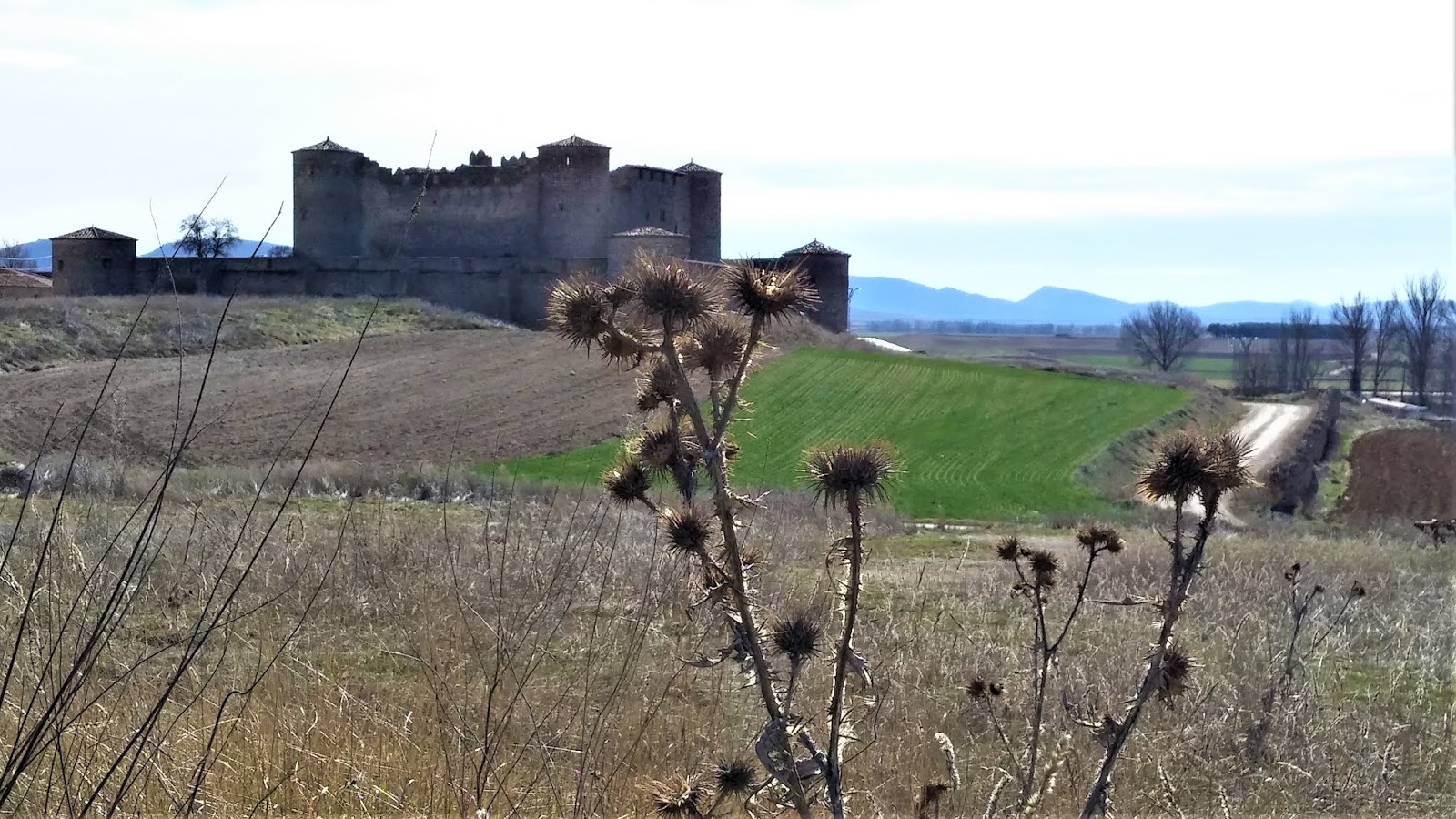
Almenar Castle with the bridge over its moat, which is behind a locked gate 
The biggest surprise was the existence of the castle. It shouldn't have been a surprise, since "Almenar" refers to a battlement or watchtower, but there it was, with its own history. I regret that we couldn't find anyone to open the castle up to us, because from there, the views of the valley would have been the most impressive.

Some sources say the oldest parts of the castle are contemporary with my characters, the tenth century. This would be parts of the homage tower or keep, which we couldn't get close enough to inspect. If there was a castle in the tenth century, then the seven noble knights would've seen the Moorish troops coming at them from around it.

Most of the castle as seen today was built in the fifteenth and sixteenth centuries and belonged to the Counts of Gómara. Carlos II and Felipe V were in residence at certain times. This castle also inspired some of the legends written by the famous Romantic poet, Gustavo Adolfo Bécquer, and it's said he lived and wrote there. (It looks like a pretty good writers' retreat to me.) There was a sign on the door we could barely make out that said something about the modernist poet Antonio Machado and his young wife, Leonor Izquierdo, staying there, as well, and I later read that Leonor was born in Almenar.

Photo 2019 Daniel Sanz 
The well-preserved castle is now privately owned.

The town of Almenar comes right up to the castle. 
Hermitage of the Virgin of La Llana,
eighteenth century. 

I'm glad the castle looms over the bucolic landscape today. The contrast between the peaceful fields and the manifestation of military power in stone reminds us of the battles, but also what so many were fighting for.

* * * 
The moment the brothers appeared once again at the entrance of the tent, the drummers gave a terrifying crash and the Moorish knights fell on them, surefooted even on the undulating slope. Gonzalo gripped his sword as his only lifeline and thrust outward, cutting and swiping at whatever he could. The Moors in charge of moving the dead and wounded took away a hundred soldiers within two hours. Gonzalo fought on two fronts: the fear rising from his darkest heart had to be beaten back at every turn, and the neverending troops had to be cut down. 

. . . and still the soldiers kept coming, with fresh horses and undamaged shields. Their prey could hardly move enough to control their own hands, and most of them had broken their shields in half and lost either their swords or their close-range daggers. 
* * * 

All excerpts from Part One, Chapter VIIII of Seven Noble Knights. 

More adventures in Soria are available at my Facebook page (March 2019), but I've saved the best parts for future posts here!