Subscribe to Jessica's exclusive newsletter

Subscribe to Jessica's newsletter

* indicates required
Showing posts with label the writer's task. Show all posts

Saturday, January 5, 2019

The Castle of My Dreams

Castle and proprietor. Count on it.
All photos in this post 2019 Jessica Knauss 
In January 2006, I was studying very hard in Salamanca. I was also getting to know the public face of Manolo Garcia as I'd never had the opportunity to before, and loving every new thing I learned, about both Alfonso X el Sabio and Manolo Garcia.

That month, thirteen years ago, I dreamed I lived in a large structure with many staircases and bedrooms. This wonderful dwelling was filled with ten or twelve writers and artists, focusing on their creations and feeling inspired by their distraction-free but gorgeous surroundings. One unassuming but popular guest was Manolo Garcia. He would give impromptu creativity talks in chambers where everyone sat on sumptuous pillows, but mostly he created, like all the other artists. He stopped me on a staircase to thank me for inviting him to my artistically stimulating refuge from the obligations of daily life, saying it had been the best month of his life.

Since then, I've known exactly what I will do with all the money I'll earn from bestselling books and unexpected inheritances. I'm inspired to run an artists' colony where writers and all kinds of creatives can practice their art unencumbered in a spectacular setting.

Fast forward ten years, ten of the best years of my life because they included my marriage to Stanley. Poking around on the internet one day in late 2015, I found a castle for sale. A Spanish castle for sale. The asking price was five million euros, which doesn't seem outlandish to fulfill one's cherished life dream, but was far out out of my prospects.

I showed the listing to my soul mate and he was happy to find out it's in the same region as Frías, a gorgeous medieval wonderland we'd recently seen and where he said many times (jokingly) that we should go and live. The region is called the Merindades, and it's the hardscrabble mountain birth mother of Castile, and thus of Spain as we know it.

Specifically, my castle is located in Lezana de Mena. It's next door to the place where the word "Castile" was written down for the first time (that we know of). The first written notice of the castle is from 1397, and it was built a few years before that for the Angulo family, one of the important landowners in the region. The construction is solid and finished with perfection in every angle. Aside from the tower, which is the only thing visible in my photos here, it has a wall and other towers and some usable one-story buildings. It sits on 22,000 square meters of gardens with fruit trees, a stream, a little forest with three century-old oaks, and a large pond. (Perfect for rhinoceros grazing, but we'll think about that later.)

The price, to me, is further justified because it boasts state-of-the-art central heating; a heated swimming pool with geothermal technology, a wave generator, and spa jets; all new plumbing; double-glazed windows; a centralized vacuum cleaning system; satellite telephone system with Wi-Fi, TV in all rooms, and motion detectors in communal areas; five open fireplaces, three of which have inserted cassettes with hot air impellers with insulated stainless steel flues; solid oak beams and stairways; floors made of oak, chestnut, and northern pine; six bed chambers with on-suite bathrooms, two with walk-in wardrobes; three powder rooms; a library; a large refectory; public rooms; a kitchen; and an elevator!

And now the asking price has been reduced to less than three million euros!

This first week of January 2019, I had the chance to visit my castle for the first time, so of course I seized it! Driving north from Burgos, my friend and I were aghast at the constantly changing countryside. Just looking through the window filled me with gratitude. "If you like Castile," said my friend, "it doesn't get any more authentic than this!"

Passing by innumerable Romanesque churches and other castles I don't currently have plans to buy, weaving through the mountains, we at last came around a bend and my castle presented itself to me like a gift from Spain, the entity I've loved longest and hardest. It was apparent that the castle wasn't open to visits from tourists (But I'm not a tourist! I'm the future owner!) before we even parked.

The town surprised me with its lively atmosphere. It lacked the sense of desolation you get in a lot of towns on the Castilian plain, and felt welcoming. We had tea in the bar across from what looked like the castle's front gate, while I was champing at the bit to get outside and take photos and commune with my castle. The lady who made our tea gave us the low-down: Indeed, no one is allowed in the castle unless they intend to put their visit in a high-visibility publication or have documented ability to buy it. Even so, I didn't feel turned away. I had a strong sense of being in the right place, which is something I haven't felt in my life very often.


The castle passed into the Velasco family in the early fifteenth century, a time full of conflicts between nobles and uprisings at all levels. The Velascos had countless castles all over what is now northern Castile, claiming their territory and warning against any and all transgressions of authority. Wouldn't it be ideal to have an invasion of writers and artists in this beautiful space to encourage the sense of peace that now blankets this valley? 

Generous donations graciously accepted, serious investment queries gladly entertained. 


Monday, July 24, 2017

Here Be Unicorns: The Tin House Summer Workshop

I read my heart out in the splendor of the Oregon outdoors.
Photo by Laura Citino 
Last July was the worst in my personal history, and this July is giving me no reason to love it at home. I'd heard of the Tin House Summer Workshop for writers and decided to apply for it, not imagining I would be accepted, but hoping it could be a way to spruce up a rotten month if I somehow were able to attend.

I was accepted! I agonized over whether to attend for about an hour. In the end, I decided good things are few and far between and I must take these opportunities when they come. 

Am I glad I did. There are few things I would trade that week for. I learned so much about writing, I think I could teach it. I met some rock stars of the publishing world, and they were all good human beings—no egos darkened the week. Most secret and alchemical of all, putting so many writers together to work with each other creates a sense of belonging like I've never experienced. If you are a writer, do Tin House. Even if you never do another writerly community activity, apply and apply until you get in to this one. You won't regret it. 

The bookstore displayed a few of the faculty's magisterial titles. 
This summer, we enjoyed meeting and talking shop with stellar faculty: Margot Livesey, Saeed Jones, Danielle Evans, Karen Shepard, Renee Gladman, Joshua Ferris, Manuel Gonzales, Morgan Parker, James Hannaham, Naomi Jackson, Emily Witt, Jim Shepard, Claire Vaye Watkins, Roger Reeves, Kelly Link, Aimee Bender, Natalie Diaz, Anthony Doerr, Mat Johnson, Paul Lisicky, and Mary Ruefle. Additionally, there were agents and most of the editors of Tin House. Everyone took students' work seriously with naturalness and humility that make the world a wonderful place. They divulged their deepest writing secrets without prodding. We were all there for the same reason: to celebrate and create good writing. 

We were accompanied at all times by ravens. They scavenged during our outdoor meals and made portentous paths across the sky at the evening readings. For many, ravens are frightening, but for someone who's seen them up close at the Arizona-Sonora Desert Museum, they're marvels of nature. Many and many a year ago, my old pal Eddie granted them a literary air that felt appropriate for the week. 


Visitors to campus that week got the impression
Oregon is a sunny, warm place. 
Word was that the janitorial staff hates Tin House week because the attendees are always drinking and getting locked out of their rooms. I did neither, but still had a rich, socio-psychologically complex time. I can only report on a fraction of what we packed into that week.

I'd already been deeply impressed with the quality of the other participants' stories as I read them in preparation for the week. I got the feeling I would be working with writers who were not only better than me (which is ideal in a workshop situation), but also were just as weird or weirder than me. Normally, I'm the only writer in a room who's heavily influenced by magical realism and worships the unexpected. I had trouble identifying the emotion that rose up within me when we all met for the first time—could it be a sense of belonging? I feel it so infrequently now that my true love is gone, it seems overly sentimental and out of place, but oh, if I find it again, I'll grab on and never let go! The workshop leader and I weren't the only published authors in the room, and yet everyone was there to listen and learn. Never stop learning. Never close yourself off to new ideas that could make you a better writer/person.

Manuel Gonzales gave a lively lecture
in which he mentioned both his unicorn story
and his friend Marie-Helene Bertino's unicorn story,
which won an O. Henry Prize. 
"Leave your preconceived notions about how a story should work at home," said our workshop leader during the orientation session. I chose to be in Manuel Gonzales's workshop because I'd read his short story collection, The Miniature Wife and Other Stories. I dared not dream the author of those crazy-beautiful creations would grant his proteges access to his mystical mastery of imagination, but I figured at least I would get to say we were in the same room for a while. 

During the orientation workshop, Tin House had everyone bring a paperback book they enjoyed in  a white elephant paperback exchange. Everyone's selection seemed unusual and exciting, demonstrating their eclectic tastes. Manuel Gonzales presented his book last and explained it was no used copy but something he bought specially. It was worth the wait—the lucky student to his left received The Princess Bride, which he admired for its humor and daring narrative techniques! A dopamine rush for at least this student! I knew then that I'd made the right choice.


Gonzales's dynamic reading convinced me to buy his novel, The Regional Office is Under Attack! In his masculine voice, I heard the fast-paced self-deprecation of his sassy young female protagonist. I can't wait to read it, especially after I heard a bit about the book's journey from idea to published novel. The lecture he gave, "In Particular, The Universal," discussed the way fine details help readers relate to the characters and story and take it as their own. He's often asked what his unicorn story is about. It's about a unicorn. It must be a real, physical unicorn before it can take on any further meaning. To take an example from Marie-Helene Bertino's O. Henry Prize–winning story, in order for her unicorn to symbolize inherited family burdens, we must first imagine what would happen if someone tried to transport a real unicorn in an SUV. (It would eat things it shouldn't and do its business everywhere. It's the writer's job to depict exactly what it ate and ruined and how—but only if it adds to the story.)  


Eleven other writers and I were lucky because we got to spend hours with Gonzales, while everyone else got only the short reading and hour-long lecture. He made it clear from the beginning that stories are serious business, and his critiques were jaw-droppingly perceptive, but he approached our work with a biting sense of humor and bone-dry delivery that had us laughing the entire two-and-a-half hours the workshop lasted every day. In the middle of the week, someone from a neighboring workshop came to the door to tell us to keep the noise down. "You can't keep us from loving each other," he retorted, though I'm not sure anyone else heard, because they'd already found the request so humorous. While I perceived straightforward love and tenderness in the other workshops, our atmosphere felt unique. Respect and equality were established among us with vigorous ribbing and creative antagonism no one else seemed to understand.

Our group dynamic followed a character arc I'm not at liberty to discuss here, but it involved a lot of cleverness, trivia night, and the O. Henry Prize. The well-earned finale was when, after the last workshop, one of the students returned from her individual consultation to tell us, "He said he really enjoyed working with us!" Hallelujah, amen. 

In other events of note, a mindfulness seminar run by none other than Aimee Bender's husband brought sanity to the beginning of each day. Writers being as crazy as any other artists, the seminar was an excellent idea I hope they bring back.

Last but not least, my true love was with me for all the ups and downs. He was perhaps most present when I attended Aimee Bender's reading and brought my hardcover of The Color Master for her to sign. I'd bought it when the book first came out, when Stanley and I were living in a hotel in North Carolina. The first edition has an embossed title that's a tactile delight, and Aimee greeted it like an old friend. I told her how Stanley and I had read all her books to each other, and I silently remembered the feel of the hard couch in the hotel and the bizarre futon we had during our lean Arizona years, and the way Stanley would tell me, with his heart-melting voice, his unique impression of each story as soon as I finished. Aimee wrote the lovely inscription pictured, and I retreated to my room so no one would see me weeping widow's tears.

Get more tangible details about this week at Drew Ciccolo's blog post. Takeaway: Always walk back from Safeway!

Thank you, Tin House and everyone who attended.

Tuesday, June 27, 2017

Wisdom from the Historical Novel Society Conference 2017

Huge quantity and huge quality authors at the book signing, with yours truly 

I'm back from the Historical Novel Society Conference 2017 in Portland, Oregon. I'd been planning to go to this convergence of great historical fiction authors from all over the world since they announced its location last year, not knowing at the time that I would be so close, I wouldn't even have to book a plane ticket.

The view from the hotel room where I missed my husband 

I participated in so many fun, informative, happy, and intense events! It was no time at all before someone commented that most authors are introverts, so we all must be exhausted from social activity that we desire and enjoy but that drain our energy. I was not the only one who wondered if it was too much fun. I'll try to sum up each event with a word or two of wisdom.

FYI, telling people you're going to be living in Spain soon is a great conversation starter!

Selden Edwards and Irene Goodman 

Perhaps it was foreshadowing for the way the conference would go. I began at the preconference academy with courses on how to start your novel to grab your readers so they can be entranced by the dynamic pacing you maintain throughout. First, agent Irene Goodman and author Selden Edwards offered oral histories that were models of pacing that kept the audience hooked no matter how much they meandered. They dissected what worked with many examples of first lines. It's the perfect exercise for any novelist to look at the first lines of a wide range of first lines of novels and think about why or why not you want to keep reading, looking at tension, suspense, lively words, and specificity.

Irene Goodman gave a memorable example written by no less than her own daughter when she was young: "It started with ordinary carrots." The sentence has so much more tension than the typical "Once there was..."

Heather Webb had us at Hello. 

Heather Webb continued the learning with the first half of You Had Me at Hello. I'm having tremendous trouble getting the sequel to Seven Noble Knights started. Heather looked at my pages and gave me an idea for a new start that will better hook the reader with characterization, and mystery, and obvious stakes, tone, time, and place. (Yes, it's even harder than it sounds.)

Gillian Bagwell had us at Hello and goodbye. 

Author Gillian Bagwell entered in signature polka dots and dropped the bombshell that dialogue can do a lot of the heavy lifting of exposition and description. Drawing from her time as an actress, Gillian illustrated arcane writerly secrets in fresh and entertaining ways. If I don't nail the beginnings of all my books and stories from here on out, it won't be the fault of these fantastic instructors.

I've known author Kim Rendfeld for years,
but we met for the first time at this conference.
The digital age actually can bring people together. 

On the first day, the welcoming atmosphere, the sense of writerly support, and the openness to always learning were already apparent. I've been to a few conferences before, and there are always a few notoriously negative presenters or attendees. Not here.

Irene Goodman and editor Lucia Macro started off the wise positivity the next day, advising us that selling your first book is the good news and the bad news! They made me wish I had their jobs, warts and all.

Seven Noble Knights in excellent company at the Barnes and Noble display 

Author Carol McGrath suggested ways to invent convincing medieval heroines to an intimate "Koffee Klatch" group of my peeps, medievalists. When we present our women characters as strong, some readers complain that they seem too modern. But really, to survive the Middle Ages, they had to be. We discussed the obstacles women came up against with Carol's memorable advice that if you need to give female characters opportunities, send the men to war. Medieval Spain was in a constant state of war, so that is excellent advice for any of my future stories.

Anne Easter Smith, Aimie K. Runyan, and Stephanie Dray revel in
researching archives full of accidental—or deliberate—holes. 

In the wonderfully titled How am I Supposed to Write About This When They've Destroyed All the Evidence?, Anne Easter Smith, Aimie K. Runyan, Stephanie Dray, and Kim Rendfeld discussed the frustration and fascination of having to solve some of history's most entrenched mysteries to move your story along. Anne made convincing arguments that Richard III did not have the princes in the tower killed. When to make it up because nobody really knows was thoroughly discussed. What constitutes a good faith effort for you as a writer?

I didn't get close to Geraldine Brooks, but she was inspiring from afar. 

Geraldine Brooks spoke at lunch the first day. She entranced the audience talking about her career as a war correspondent journalist, how she got into writing novels, and how she gets her book ideas with the concept of implausible history: true events that no one could make up. Describing the sympathy both authors and readers can feel with characters in spite of geographical, cultural, and temporal distance, she said, "She loved as I loved, and that's as good a place to start as any." Read more at M. K. Tod's blog.

That afternoon, I participated in the Blue Pencil Café as a mentor. I wasn't sure what to expect, but both of the writers whose first chapters I'd read were highly receptive and ready to learn. One had just pitched to an agent and received a request for pages, so that added thrilling intensity to the revision process we were discussing. I'm glad I had the opportunity to participate in some other writers' process.

Cold Reads but a warm reception from Lucia Macro,
Anna Michels, and Margaret Porter 

On the heels of thinking about revising first chapters, I attended a Cold Reads session with editors Lucia Macro and Anna Michels and author Margaret Porter. Margaret read the first two pages of twelve unpublished novels submitted by the session attendees and the editors told us what worked for them and what didn't. The most egregious sins were the samples that didn't make the setting and time period clear. I went to a similar but infinitely more brutal session at The Muse and the Marketplace, the Grub Street conference, in 2014. In the end, it made the beginning of Seven Noble Knights 100 percent better, but I had to process it for a long time because the information was delivered in such an unsympathetic way. I wished I'd had some pages to give to these ladies, because I learn more easily in a welcoming environment like this.

The only thing lovelier than this many historical novels for sale is Powell's Books. 

That evening, I went to dinner with Kim Rendfeld and Rita Ashley, whose pages at the Cold Reads session provoked extensive discussion because they were masterfully written but described a child in distress. Apparently, that's a major turnoff for publishers because so many of them have children of their own. We followed dinner with a visit to a Portland institution, the ice cream parlor Salt & Straw. The menu is thrilling reading in itself and I hope I have a chance to go back there before I leave for Spain.

My name tag says Jessica K. Knauss—Medieval Spain. 

Bright and early the next day, I went to possibly the most informative session, How Far Can a Horse Walk in a Day and Other Questions of Accurate Historical Travel. Mary Ann Trail let us in on the secrets of Paterson's Roads, British military records for invading Scotland, which led quickly to the first travel guidebook, complete with inns, the cost of renting horses, best routes, and road conditions—all the nitty gritty details a historical novelist needs. Faith L. Justice took our breath away with Information Age ways to get at travel as far back as Ancient Rome. The best advice was to become the best friend of your local research librarian!

Stephanie Lehmann illustrates coming up against unique challenges
with Patricia Bracewell, Rebecca Kanner, Mary Sharratt, and Nicole Evelina. 

High on potential knowledge, I entered Putting the Her in History, which had possibly the best energy of any of the panels. Women come up against challenges unique to them throughout history, and yet only .5 percent of recorded history is occupied with women's lives. Each panelist had an interesting story to share, whether about her heroines or how she is perceived as a writer who is a woman. Rebecca Kanner has been asked why she's so "stuck on violence," and we imagined no male author has ever been asked that question. Such dynamics are one reason I decided to use my initials for Seven Noble Knights. Most inspiring, of course, was the idea that writing about women validates our stories and lets us know we're important. Read more at Patricia Bracewell's blog and Nicole Evelina's blog.

David Ebershoff, also dynamic from afar 

The speaker at that day's lunch was author David Ebershoff. He described how he came upon the information that inspired The Danish Girl and how he struggled with whether to write the story at all. He had a vision of how much he would regret it in the future if he didn't write it, and we're all glad for that. Every author at the conference writes because s/he feels deeply that a certain story must be told. Getting David's humble take on that passion, complete with museum visits, grave sites, and film crews, validated the struggle and hard work.

Geraldine Brooks, Ed Goldberg, David Ebershoff 

I now share an honor with Geraldine Brooks and David Ebershoff—we've all been interviewed by Ed Goldberg! It was an hour full of anecdotes and pithy replies to clever questions from the audience.


Then we filled a vast ballroom with more than a hundred historical fiction authors for the book signing. So much talent in one place! Because we were grouped in alphabetical order, I seized the opportunity to chat with authors I hadn't been able to catch until then, including Patricia Bracewell, Susan McDuffie, Lucy Pick, and Judith Starkston. Believe it or not, Seven Noble Knights didn't sell out, so Barnes and Noble has a few copies signed by the author available for purchase. Check it out online if you're not local to Portland.

Kate Forsyth 

Entertainment for the closing banquet included an enchanting recitation of the Scottish folktale Tam Lin by Kate Forsyth.

The masquerade ball off to a great start with George Washington and Alison Stuart 
The whist games provoked many shouts of victory. 

To cap it all off, a regency masquerade ball—but of course—complete with tables for playing whist, as all good regency characters do. I chose a red mask even though the purple would've matched my dress better.

The only place where a medieval gentleman can hold hands with Marilyn Monroe 

The Jane Austen Society provided authentic live music and instructors for the dance and the whist. I would likely have hung back, but author Stephanie Renee Dos Santos pulled me in for the first round of dancing. The instructor taught each dance for ten or twenty minutes before we really did it while he called out the moves, and it had a strong feeling of square dancing, lots of holding hands, promenading, and changing partners. I was exhausted!

This dance reminded me of a Goya painting. 
This one is straight out of Jane Austen. 

Many thanks to the tireless organizers and every attendee, who made this conference joyfully worth every penny.

Each person mentioned in this post is connected in some way to at least one excellent historical novel worth checking out.

Monday, December 5, 2016

Violently Happy

Prepare to get your medieval on!
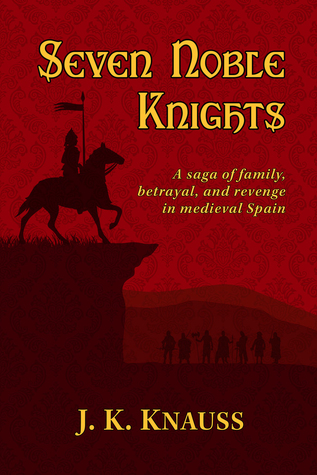
Seven Noble Knights is on its way! 
Seven Noble Knights is coming out in only ten days! It's available for Kindle preorder now! The Grand Book Launch Blog Tour has already kicked off, and be sure to attend the Facebook launch party on December 15 for fun and prizes!

The Seven Noble Knights release is giving me emotions so intense, you might call them violent.

The end of a productive three-part discussion on violence in storytelling by David Blixt came at an a propos time, in the aftermath of the Red Wedding episode of the Game of Thrones series. It's well argued—check it out!

I've never been sure why I was so strongly drawn to the story that is the basis for Seven Noble Knights. It's violent, and I've never enjoyed stories that showcase violence for its own sake. So, it became my mission to present the violence in a way that would affect the reader deeply at the same time that it examines the conflict from both sides and humanizes the villains. Conflict is necessary for story, and a good story will show the conflict in all its subtlety and let the reader decide what it really means.

After all, this is not a new story. It's already been told, in quite a few different ways, so there's no point in retelling it unless I add value in the form of sympathetic characters with believable motives and emotions.

I began by trying to understand why the woman who motivated the biggest violent act in the entire book—Doña Lambra—was moved to such outrageous and unbecoming behavior. Because I started with her, I fell in love with her, and deeply confused my beta readers and some people who read my first attempts at query letters and a synopsis. I also loved the proper "good guys" in the book, but the fondness I had for writing about Lambra skewed readers' perceptions of the González family in the wrong direction and failed to prepare them for the meaning of the gore to come. I've done a lot of editing to resolve this and think I've ended up with a complex balance of characteristics and perceptions in both camps. Anyone can write a good hero, but a good villain is the mark of the great writer I want to be.

It's an epic story and I hope I've given each character the attention he or she deserves.

Anyway, if you liked or understood or enjoyed being devastated by the Red Wedding, Seven Noble Knights has incidents that I hope affect the reader in a similar fashion.

It's coming out this week, December 15! I hope you've been enjoying the blog tour. Be sure to come by the Facebook launch party on December 15 for fun and prizes!

Remember to put your name in to win one of three first edition softcovers.


Goodreads Book Giveaway

Seven Noble Knights by Jessica Knauss

Seven Noble Knights

by Jessica Knauss

Giveaway ends December 14, 2016.
See the giveaway details at Goodreads.
Enter Giveaway


Monday, July 11, 2016

Interview with Award-winning Historical Fiction Author Jana Petken

Today I'm thrilled to welcome Jana Petken, who writes extraordinarily good historical fiction (some of it set in Spain) as an extension of an extraordinary life.


Jana Petken served in the British Royal Navy as a leading Wren Regulator, equivalent to a sergeant in the military police.

After the Navy she worked for a travel company as an overseas representative.

She was a security guard at the BBC World Service radio station. Afterwards she spent twelve years as a bodyguard for a Saudi Arabian Princess.

Her final career was as a cabin-crew member for British Airways. Unfortunately, she suffered serious injuries on board a flight. The aircraft, a Boeing 747, was flying at 39,000 feet above Africa when it was caught in clear-air turbulence. As a result of that accident, she endured three major operations on her spinal cord, and was forced into retirement.

Jana Petken is a multi-award-winning and best selling historical fiction author. Her books include:
The Guardian of Secrets. (2013)
The Mercy Carver Series: Dark Shadows, book 1, and Blood Moon, book 2. (2014)
The Errant Flock: The Flock Series, Book 1. (2015)
Swearing Allegiance. (2016)
Coming Autumn 2016, The Scattered Flock: The Flock Series Book 2.

JK: I notice some of your novels are set in Spain, the country that occupies my heart and mind 99% of the time. Please tell us about them.

Jana Petken: I have two books about Spain, with a third on its way. The first is The Guardian of Secrets, a Readers’ Favourite 2015 silver medalist. Here’s a little bit about the story.

After fleeing from an abusive husband accused of murder, Celia Merrill becomes embroiled in a Spanish Civil War.

Celia’s two sons march under opposing banners, whilst her twin daughters take different paths; one to the Catholic Church and the other to the battlefields. And in the shadow of war, a sinister villain from the past resurfaces.

"Three generations struggle in this suspenseful and compelling saga, which begins in 1912, Kent, England, and ends during the 1936–1939 Spanish Civil War."

The Errant Flock is a two-part series, with the second in the saga being released in October. TheErrant Flock was a top 100 book, across all genres, according to Shelf Unbound magazine, in 2015. It also won a 2016 silver medal, at the Independent Publishers’ awards, the IPPY’s.

Valencia, Spain, 1491
The ambitions of four men merge and collide in a deadly game of intrigue.

David Sanz, a young militiaman, is forced to carry out a heinous crime, and he becomes an unwitting pawn in a tense battle for power.

Luis Peráto, the duke of Sagrat, sacrifices his own people to cover up dark secrets that could see him burnt at the stake for treason.

Sergio Garcia, Sagrat’s lord treasurer, is a cruel and unscrupulous man, willing to eliminate anyone who opposes his rise to power.

The inquisitor, Gaspar de Amo, zealously punishes heretics for their sins against Rome and her Holy Office. But bringing the Inquisition to the town of Sagrat proves more challenging than he or the church could ever have envisaged.

In the midst of chaos, the people of Sagrat, terrorized by a series of murders, face an even greater danger with the arrival of the Inquisition and the unimaginable horrors it brings.

Jana Petken with her well-earned IPPY award. 
JK: What inspired you to write about Spain? 

JP: I grew up in Spain. It’s a country with a rich history and one can’t help but be fascinated by times gone by. Once an empire, it evokes colourful characters, from Don Quixote to its kings and queens, seafarers, Inquisition, and civil war. The historical material is massive, and I want to let the rest of the world to know about it.

JK: How do you research all this great material?

JP: My research goes deep. I suppose I’m lucky, in the sense that I know the Spanish culture and its people pretty well. Having said that, I work hard to bring facts to life, merging them with the story, but hopefully, not overpowering the fiction and entertainment value for readers. I also love being able to research subjects close to home, geographically.

JK: What do you do when you're not writing?

JP: When I’m not writing, I enjoy doing simple things. As an author, I don’t believe I ever really switch off, but I do enjoy walking in the country and by the sea. I love to paint in oils and socialising. I’m also love to lie back and watch a good TV series or two.

JK: It really all counts as research! Thank you for being here today.