Subscribe to Jessica's exclusive newsletter

Subscribe to Jessica's newsletter

* indicates required
Showing posts with label travel. Show all posts

Wednesday, February 16, 2022

The Exhibits I Waited 800 Years to See

Me and the most important men of letters of Spain

I wrote Our Lady's Troubadour for Alfonso X's 800th birthday. I was largely under the impression that most celebrations had been canceled or curtailed by the pandemic. But, wonder of wonders, the two most appropriate institutions in Spain recently had exhibits in honor of this grand anniversary. 

The exhibits were appropriate because Alfonso was the Learned King, and the exhibits were of his books: the books he had his scholars research, write, lay out, and decorate in his court, and which he would've inspected to make sure they were to his standard and then left for future generations in his testament. Those books

The places housing the exhibits were appropriate because they're the two most important libraries in Spain. Even the humblest of libraries is a temple of learning. These buildings, with their grandeur and special designs for preserving and honoring books, are cathedrals of learning. 

My new knight in shining armor and I have been crazy busy, but when I saw that these once-in-a-millennium exhibits were about to end, we made a special trip, right around Valentine's Day. Books = Love. 

First, "The Books of the Wise King" at the National Library of Spain in Madrid. 

That illuminated A... I would wear a shirt with that on it! 

The mask keeps the drool from hitting the glass cases. 😉 Yours truly with the To codex of the Cantigas de Santa Maria

Just flipping out with a display of the E codex Cantigas presentation miniature. I'm practically in Alfonso's colorful court! 

What we all came for right up front: the To codex of the Cantigas de Santa Maria, produced at the court of Alfonso X and personally approved by the king. With about 100 cantigas, it's considered to be the first part of a project that just kept growing. 

I can't emphasize enough that these books are deluxe and that it's a miracle we can decipher the musical notation today and enjoy these beautiful songs. The manuscript is open to Cantiga 37, a miracle about a man whose foot hurt so much he cut it off. The foot was replaced when he asked St. Mary for help.

The greatest law treatise of Alfonso's court, the Siete Partidas, this time in a copy for Queen Isabel I. I studied this and other law treatises for my doctoral dissertation. The confidence and clarity with which these scholars wrote in a language that had only been written down officially for about fifty years is stunning. 

The other great law treatise, the Especulo, predecessor of the Siete Partidas, in a copy from the fourteenth century, which is the only medieval copy the National Library has.

A beautiful codex of the Fuero Real, a royally sanctioned municipal law code. This one was granted to Valladolid in 1255, just three years into Alfonso's reign. 

Display of the presentation miniatures of a codex of the first Partida that is held in the British Library. I'd only ever seen black-and-white reproductions before. Unlike traditional medieval European presentation miniatures, instead of a scribe presenting a completed book to the person who asked for it to be copied (usually a king), here King Alfonso dictates the contents of the book and looks overhead at the book's inspiration and eventual recipient: God. 

Display of the presentation miniature from a History of Spain codex from about 1280. The king tells his historians what to write and points to his heir, Sancho, who will become Sancho IV. 

The General History was meant to be a history of the world from ancient times to the thirteenth century (their present day), but only made it to the first century AD before Alfonso's death cut the project short. This massive codex is from the royal scriptorium, about 1270, and is only the first part.

A closeup of the beautifully legible text (you can't become learned if you can't read the texts) about the lineages of Jacob, General History.

Display of the beautiful colophon of the Book of the Canons, an astronomy treatise. The red and blue part reads, "Here ends the book of the canons the most noble King Don Alfonso ordered to be written. May God grant him life and good health for a long time."

The Book of the Crosses, an astrology treatise from 1259, signed by its translators, Yehuda ben Mose ha-Kohen and Juan de Aspa.

The Complete Book on Scrutiny of the Stars, about 1254.

The Tablas Alfonsies were astronomical measurements taken at Toledo for Alfonso X between 1263 and 1274, and were used by scholars all over the known world for hundreds of years thereafter. This manuscript is from Paris, about 1320.


A History of Spain from the beginning of the fourteenth century (after Alfonso's death).

Finally, a feminine touch: Queen Isabel II, who helped found the National Library. 

Out front, twentieth-century statues of the greats of Spanish literature. Here, Vives (father of psychology) and Nebrija (who wrote the first Spanish dictionary, 1492). 

Lope de Vega and Miguel de Cervantes, who I suppose don't need further introduction. 

Isidore of Seville, a Visigoth (c. 560 - 636) who takes pride of place here because he wrote Latin Etymologies that have been an important reference ever since.

And the star of all learning, Alfonso X, el Sabio. 

This statue exercises a particular attraction on this book nerd. In his hand, he holds a sheet from the Siete Partidas. It was probably hard to decide which branch of learning to represent with this medieval  Renaissance man. 


Mario and I walked back to where we'd parked through most of monumental Madrid. It's such a wonderful place to visit! Here I am with another statue of Cervantes across from the congress building. 

The very next morning, we headed to El Escorial in the mountains around Madrid for "Codices of the Wise King."

The monastery of El Escorial was built for Felipe II according to Neo-Classical architectural principles of reason, proportion, and balance. It has the most important manuscript library in Spain. 

I liked that my mask had the same image on it! 

This exhibit was, if possible, even more mind-blowing because all the manuscripts were from the court of Alfonso X, books the king himself would have touched and marveled at (or possibly pointed out the flaws in), including the E and T codices of the Cantigas de Santa Maria, which obviously I have some affection for. 

In the beautiful library, a veritable temple of learning. Absolutely electrifying! But at the library of El Escorial, they never allow photos. So you'll have to take my word for it. 

This was as close as I got before they started yelling not to take photos. I really think it should be apparent that I am not there to harm the books in any way, shape, or form. 

I'd like to note that the ceiling of the library is painted with symbols of all the branches of learning. Alfonso X appears in the section for astronomy, with a tablet and an astrolabe. 

Mario and I spent a good hour and half poring over the exhibit of nine manuscripts, so we got our money's worth. 

The gift shop had many beautiful items with cantigas and Book of Chess designs on them, and of course I nabbed a few. 

Back in the car, we decided on a strategy for lunch, and suddenly the whole couple of days came crashing down, and I sobbed with the emotion. Yes, it meant that much to me to see these books in person. With someone who encouraged my passion, no less. 

I don't always weep with gratitude, but this occasion certainly merited it. 
 

Friday, November 6, 2020

Lands of Legend: The New York Public Library Invites You


We all miss those magical times when we could travel. Now you have a chance to travel without leaving the safety of home. 

If you missed this event, scroll down for links to the special video replay of the content. 

Thanks to the generosity of the New York Public Library, you can join yours truly, author of Seven Noble Knights, on a Google Meet virtual tour of medieval and modern Spain. You'll learn the legend of the seven noble knights, see the places where it all happened, and learn the ways Spanish people today celebrate this legend. Photographs, anecdotes and excerpts bring this fascinating country alive. I'll also answer your burning questions!

Register at the bottom of the page linked here, under the book cover and my photo, to receive a link to this program with a reminder 10 minutes before event. 


You can preorder Seven Noble Knights so that you'll receive it on release day, December 11. 

Or, if you're a NetGalley member, you can pick up your review copy right now and ask questions about the story on December 5! 

Lands of Legend await you! 


This event went really well, with lots of engaged audience members. I've recorded a special replay of the content for those of you who couldn't make it on the day, available in four parts: 

Part 1 | Part 2 | Part 3 | Part 4 | Facebook page

Enjoy! 

Sunday, October 11, 2020

A Legendary, Epic Road Trip

Lara. I took this photo through the car window because 
it was too cold to open it. 

It's only two months until Seven Noble Knights becomes available from Encircle Publications! What better way to celebrate than by remembering a "legendary" road trip where I unexpectedly met my characters. 

In January of this year (that nostalgia-inducing time before the pandemic arrived), I went to beautiful Burgos to visit my friend Daniel. Burgos in January is not for the faint of heart. But at least they're used to the cold there, and build their apartments accordingly. 

As you might imagine from previous posts, Daniel and I are far too intrepid to let a little freezing temperatures keep us inside the apartment staring at each other. "Let's take a drive through Lara, where your novel Seven Noble Knights is set," he said. 

Formidable hills in Torrelara 

I'd seen a little bit of Lara on a few occasions, but my friend was ready to show me "deep Spain" as I'd never seen it before, so I put on all the layers I'd brought and borrowed a couple more, and off we went. 

This rings a bell... 
Mambrillas de Lara 

We were minding our own business, looking for things like Romanesque architecture and dinosaur tracks, when there appeared to be a random scene from Seven Noble Knights painted on the side of a building. My frisson of recognition was confirmed when we saw the other corner of the building: 

It couldn't be anything other than the scene with the foreboding flights of birds before the heroes head off into battle. I was practically out of the car before it stopped. 

My heroes and me in Mambrillas de Lara 💖 
All the "Legendary Murals" in one photo
in a pub in Cubillo del Campo 


Wonder of wonders, when we read the informational plaque beside the mural, we discovered that this beautiful two-sided mural is part of a series that tells the entire legend upon which Seven Noble Knights is based! 

I snapped a photo of the map of the mural route, and we were off. We had inadvertently started at mural 5. Geography, hunger, and cold kept us from finding all ten, and we didn't find them in order, but I will present the legend in order (except mural 5) to you here. Subtle spoilers ahead! 

The tip of Los Ausines 
We found mural 1 on the edge of Los Ausines. When I say the "edge," I mean it: Los Ausines is a picturesque town wrapped around an oblong rocky outcrop. The photo doesn't do it justice. 

Blood Wedding by artists 9 Mil Siete 

The doughty knight cutting a handsome figure in mural 1 is meant to represent Álvar Sánchez, beloved cousin of the antagonist, Doña Lambra, whose wedding turns bloody. She wishes she were marrying Álvar, but no, she's obliged to marry Ruy Blásquez, the uncle of the seven noble knights. The blood starts to flow when Lambra's new nephew accidentally kills Álvar Sánchez, who in my book is a little annoying, but certainly doesn't deserve to die. 


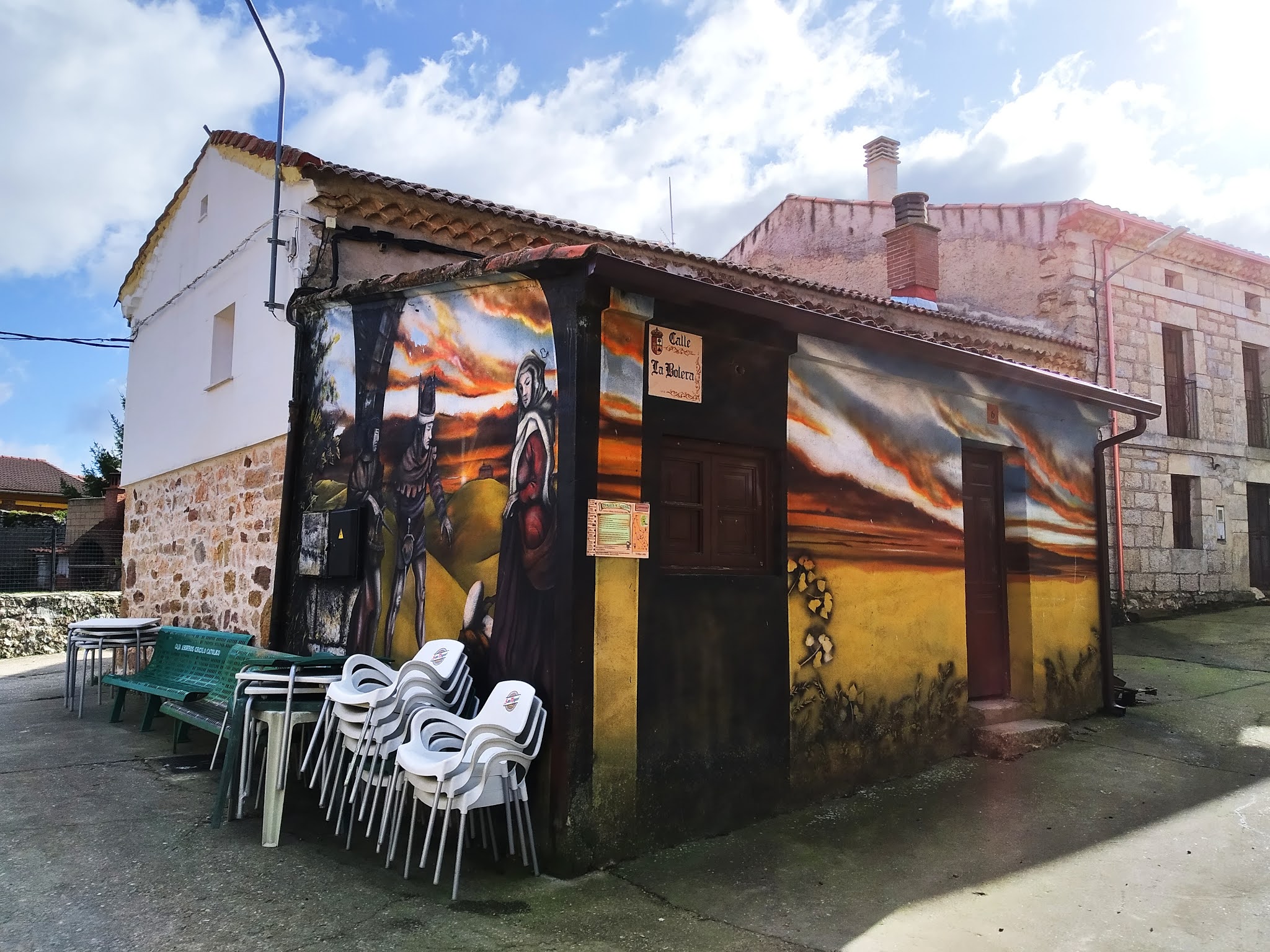
The map only indicated which town each mural could be found in, but actually seeing the art often required significant digging. We found mural 2 wrapped around a small building in Quintanalara only after we'd given up and decided to have a hot tea to warm up in the town pub--which was directly across from the mural. 

Death at the Feet of Doña Lambra by RAF-ART

Daniel moved the chairs so I could get a better photo. The fact that there's an electrical grid and a bench stuck right into the painting points to the way the people of Lara live with this legend every day. 

This painting shows the second affront suffered by our antagonist, Doña Lambra, when a huge misunderstanding results in the death of her servant at her feet. I like this painting very much, but feel this mural series missed a great opportunity to portray the most bizarre scene in the legend, the bloody cucumber incident. It's what caused the "misunderstanding," after all. Not to worry, no scenes are missing in Seven Noble Knights. I included it all. 

Church of San Millán, Torrelara 

Mural 3 eluded us for some time, until we asked a resident of Torrelara where to find it. We had to climb one of the town's many hills, where it looks out at the landscape from the summit. 

Shouts of Revenge by Rodrigo 

This painting portrays our villainess crying out in grief and rage for the crimes the noble knights committed against her. She demands her husband, Ruy Blásquez, take revenge on his own nephews. What can he do? He promises he will. 

Quintanilla de las Viñas 

Quintanilla de las Viñas is a town I've been in before, spectacularly, never knowing that it participated in the mural retelling of my favorite epic legend. It's very pretty with its parish church against the backdrop of the bluff, though in the photo, it may be a little too forthcoming with its farming heritage. 

Don Gonzalo's Lament by Carlos Colio 

It's quite moving, up close. 
We missed mural 7 as we entered the town, and drove around and around, examining the sides of every building. A resident told us there was a mural as you enter the town, and after a couple of tries, we said, "Oh, that's it!" It's so very modern, it was hard to connect the disjointed art to a medieval legend, and it didn't help that neither of us expected it to be on the side of a corrugated aluminum warehouse. But there it was, symbolically telling of the devastating grief of Don Gonzalo, father of the seven noble knights. 

Mudarra by María José Castaño,
Cristino Díez, and Rubén Arroyo 

Although mural 8 sits unassuming on the side of a residence in Cubillo del César and is partially obscured by a children's playground, its imaginative composition portrays the some of the most complex imagery in this series. Called simply "Mudarra," the painting introduces the hero of the second part of the legend with details only the initiated would recognize while suggesting his person in silhouette. 


The chessboard and pieces portray his skill in that most intellectual of medieval games even while they suggest that the characters in the legend may be pawns at the mercy of a bigger story. The arches represent where Mudarra grows up, the fantastical palace complex at Medina Azahara. The silhouettes show Mudarra and his mother joined by the broken ring that will lead Mudarra back to his father. Even the hawk swooping in from the upper right is intentional and shows up in my Seven Noble Knights

Mudarra Faces His Destiny by Pedro López 

Mural 9 can be found on your way out of town in Cuevas de San Clemente, and it's the most fun, as it pays homage to classic comic books. The comic book form has a lot in common with medieval manuscript illustration, and it's an efficient, attractive way to tell an exciting story. The legend of Seven Noble Knights has been adapted into comic books on more than one occasion. Here, Mudarra finds his father, fuses the halves of the ring, tells his new family he's going to help them, and sets off to save the day (accompanied by many classic Spanish comic book characters). 

Mural 10, the grand finale, was the most extensive piece of art in the series. It's on the side of a tennis(?) court in Cubillo del Campo, and tells practically the entire plot of Part Two of Seven Noble Knights (without the psychological and historical warfare subtleties I put into the novel). We felt we were trespassing as we climbed along the uneven ground in some hearty freezing wind to look at the whole story. 

The Revenge by Susana Velasco 
I didn't manage to fit the entire piece into the shot. 
The heroes arrive in Burgos. 

After a confrontation, the bad guy, Ruy Blásquez, flees. 
Ruy Blásquez meets his end. 
Although the artistic quality of each piece varied, what we were able to see of the mural series was a delight. I love to see the way this legend is portrayed in the land where it took place, to see it outside of my head and heart and having an effect on the world. 

Daniel and I said we'd pick up the murals we'd missed, specifically 4 and 6, in better weather, but, you know, COVID. They're still in their lovely towns in Lara, and I hope to see them some post-pandemic day. 

The legend will be available to enjoy in all its novelistic complexity in Seven Noble Knights in just two more months! December 11, 2020, from Encircle Publications.