Subscribe to Jessica's exclusive newsletter

Subscribe to Jessica's newsletter

* indicates required
Showing posts with label why I write about the Middle Ages. Show all posts

Wednesday, November 17, 2021

Alfonso X's Greatest Work on His 800th Birthday

This illustration of Cantiga 235 in the F manuscript of the Cantigas
shows Alfonso X meeting a diplomatic retinue during his travels to meet with
the Pope in Beaucaire in 1275. The trip ended in disappointment, and 
much worse was soon to come... 

The historical figure of Alfonso X, el Sabio, has accompanied me through travels, trials, and tribulations for most of my life. As a human being, he was probably as complex and hard to live with as anyone, but I will always love what he stands for now: thirst for knowledge and the application of that knowledge to live better and improve the world. 

I've written about Alfonso X many times. Perhaps most important is his contribution to world culture. It gives some indication why I feel such tremendous respect for this king and scholar. 

Our Lady's Troubadour, which came out yesterday, celebrates Alfonso's 800th birthday on November 23, 2021, by adapting ten of the plots of the Cantigas de Santa Maria so modern readers can easily enjoy them and understand something of Alfonso X's world. 

The Cantigas de Santa Maria are one of the medieval compilations of miracles of the Virgin Mary. This collection is unique because: 

the miracles are told in the form of song; 

it’s a very large collection, with more than 400 of these songs, including every musical style in the Europe of their time; 

the manuscripts themselves are unique;  

the way the songs are organized has no equal; 

and most importantly, the Cantigas de Santa Maria are unique because of the personal involvement of the king. 

Alfonso X's court in the presentation miniature of the E manuscript. 
RB. Patrimonio Nacional. 

Here we see the king, Alfonso X himself, in the center of this illustration of his court from the first pages of the E codex. On the sides we have musicians tuning up, noblemen seated on pillows ready to listen, and tonsured monks ready to take dictation. Gold leaf, bright colors, happy feet jutting over the border, and blissful expressions complete a dynamic portrait of the royal workshop. The king's centrality in this picture is not casual: this is one of many ways Alfonso put his personal signature on the Cantigas. He wanted future generations to know that this wonderful book came about because of him. 

As we read the different miracles in the Cantigas, we witness all levels of daily life as well as extraordinary times. We spend time with people who have nothing to eat or are ill as well as with princes and an empress. 

For an introduction to how wonderful the Cantigas de Santa Maria are with examples, read here. 

For a more thorough but no less enthusiastic introduction to the Cantigas, read the introduction to Our Lady's Troubadour. 

For an even more thorough, documented, and scholarly approach to what the Cantigas are (where you'll still note unadulterated joy shining through), read the second chapter of Law and Order in Medieval Spain. 

I'll write more about the wide variety of topics to explore in the Cantigas in the weeks and months to come. It's going to be a fun ride! 

I'll end this strange introduction to an extraordinary king and his favorite book with my take on Cantiga 295. 


Cantigas
295 is one the happiest of the Cantigas de Santa Maria. In it, some nuns the king himself brought in to worship a certain image of St. Mary have a vision of St. Mary herself calling for the king. When he comes to lay prostrate before her, saying he would kiss her hands and feet in devotion, St. Mary says no, she wants to kiss his hands because of all the great things he does in her honor. A dream come true for Alfonso X! 

This is me singing unaccompanied, and yes, there are mistakes. But I hope you can hear the joy with which I share this music with you! Thanks for listening. 


Friday, November 6, 2020

Lands of Legend: The New York Public Library Invites You


We all miss those magical times when we could travel. Now you have a chance to travel without leaving the safety of home. 

If you missed this event, scroll down for links to the special video replay of the content. 

Thanks to the generosity of the New York Public Library, you can join yours truly, author of Seven Noble Knights, on a Google Meet virtual tour of medieval and modern Spain. You'll learn the legend of the seven noble knights, see the places where it all happened, and learn the ways Spanish people today celebrate this legend. Photographs, anecdotes and excerpts bring this fascinating country alive. I'll also answer your burning questions!

Register at the bottom of the page linked here, under the book cover and my photo, to receive a link to this program with a reminder 10 minutes before event. 


You can preorder Seven Noble Knights so that you'll receive it on release day, December 11. 

Or, if you're a NetGalley member, you can pick up your review copy right now and ask questions about the story on December 5! 

Lands of Legend await you! 


This event went really well, with lots of engaged audience members. I've recorded a special replay of the content for those of you who couldn't make it on the day, available in four parts: 

Part 1 | Part 2 | Part 3 | Part 4 | Facebook page

Enjoy! 

Sunday, October 11, 2020

A Legendary, Epic Road Trip

Lara. I took this photo through the car window because 
it was too cold to open it. 

It's only two months until Seven Noble Knights becomes available from Encircle Publications! What better way to celebrate than by remembering a "legendary" road trip where I unexpectedly met my characters. 

In January of this year (that nostalgia-inducing time before the pandemic arrived), I went to beautiful Burgos to visit my friend Daniel. Burgos in January is not for the faint of heart. But at least they're used to the cold there, and build their apartments accordingly. 

As you might imagine from previous posts, Daniel and I are far too intrepid to let a little freezing temperatures keep us inside the apartment staring at each other. "Let's take a drive through Lara, where your novel Seven Noble Knights is set," he said. 

Formidable hills in Torrelara 

I'd seen a little bit of Lara on a few occasions, but my friend was ready to show me "deep Spain" as I'd never seen it before, so I put on all the layers I'd brought and borrowed a couple more, and off we went. 

This rings a bell... 
Mambrillas de Lara 

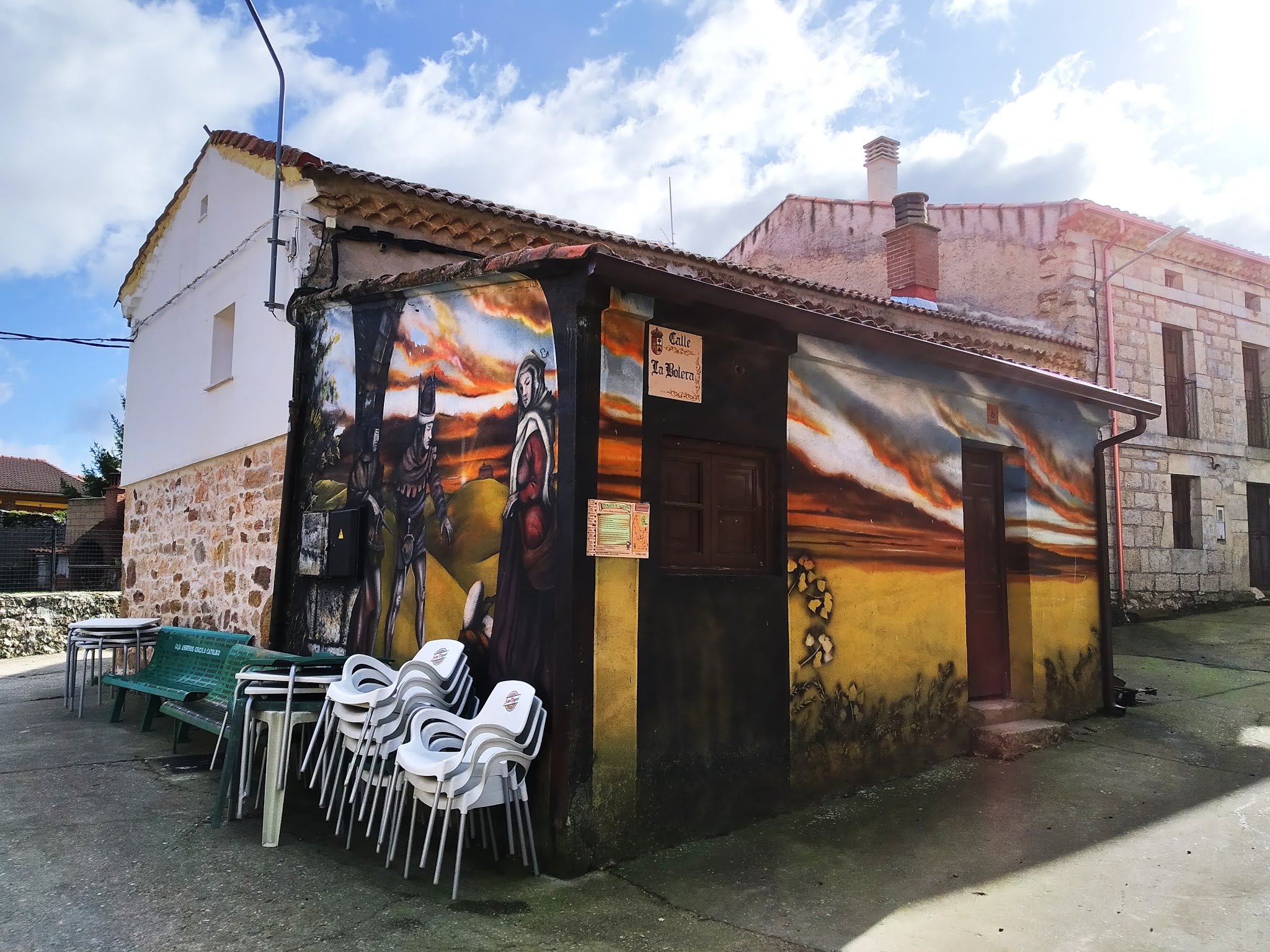
We were minding our own business, looking for things like Romanesque architecture and dinosaur tracks, when there appeared to be a random scene from Seven Noble Knights painted on the side of a building. My frisson of recognition was confirmed when we saw the other corner of the building: 

It couldn't be anything other than the scene with the foreboding flights of birds before the heroes head off into battle. I was practically out of the car before it stopped. 

My heroes and me in Mambrillas de Lara 💖 
All the "Legendary Murals" in one photo
in a pub in Cubillo del Campo 


Wonder of wonders, when we read the informational plaque beside the mural, we discovered that this beautiful two-sided mural is part of a series that tells the entire legend upon which Seven Noble Knights is based! 

I snapped a photo of the map of the mural route, and we were off. We had inadvertently started at mural 5. Geography, hunger, and cold kept us from finding all ten, and we didn't find them in order, but I will present the legend in order (except mural 5) to you here. Subtle spoilers ahead! 

The tip of Los Ausines 
We found mural 1 on the edge of Los Ausines. When I say the "edge," I mean it: Los Ausines is a picturesque town wrapped around an oblong rocky outcrop. The photo doesn't do it justice. 

Blood Wedding by artists 9 Mil Siete 

The doughty knight cutting a handsome figure in mural 1 is meant to represent Álvar Sánchez, beloved cousin of the antagonist, Doña Lambra, whose wedding turns bloody. She wishes she were marrying Álvar, but no, she's obliged to marry Ruy Blásquez, the uncle of the seven noble knights. The blood starts to flow when Lambra's new nephew accidentally kills Álvar Sánchez, who in my book is a little annoying, but certainly doesn't deserve to die. 


The map only indicated which town each mural could be found in, but actually seeing the art often required significant digging. We found mural 2 wrapped around a small building in Quintanalara only after we'd given up and decided to have a hot tea to warm up in the town pub--which was directly across from the mural. 

Death at the Feet of Doña Lambra by RAF-ART

Daniel moved the chairs so I could get a better photo. The fact that there's an electrical grid and a bench stuck right into the painting points to the way the people of Lara live with this legend every day. 

This painting shows the second affront suffered by our antagonist, Doña Lambra, when a huge misunderstanding results in the death of her servant at her feet. I like this painting very much, but feel this mural series missed a great opportunity to portray the most bizarre scene in the legend, the bloody cucumber incident. It's what caused the "misunderstanding," after all. Not to worry, no scenes are missing in Seven Noble Knights. I included it all. 

Church of San Millán, Torrelara 

Mural 3 eluded us for some time, until we asked a resident of Torrelara where to find it. We had to climb one of the town's many hills, where it looks out at the landscape from the summit. 

Shouts of Revenge by Rodrigo 

This painting portrays our villainess crying out in grief and rage for the crimes the noble knights committed against her. She demands her husband, Ruy Blásquez, take revenge on his own nephews. What can he do? He promises he will. 

Quintanilla de las Viñas 

Quintanilla de las Viñas is a town I've been in before, spectacularly, never knowing that it participated in the mural retelling of my favorite epic legend. It's very pretty with its parish church against the backdrop of the bluff, though in the photo, it may be a little too forthcoming with its farming heritage. 

Don Gonzalo's Lament by Carlos Colio 

It's quite moving, up close. 
We missed mural 7 as we entered the town, and drove around and around, examining the sides of every building. A resident told us there was a mural as you enter the town, and after a couple of tries, we said, "Oh, that's it!" It's so very modern, it was hard to connect the disjointed art to a medieval legend, and it didn't help that neither of us expected it to be on the side of a corrugated aluminum warehouse. But there it was, symbolically telling of the devastating grief of Don Gonzalo, father of the seven noble knights. 

Mudarra by María José Castaño,
Cristino Díez, and Rubén Arroyo 

Although mural 8 sits unassuming on the side of a residence in Cubillo del César and is partially obscured by a children's playground, its imaginative composition portrays the some of the most complex imagery in this series. Called simply "Mudarra," the painting introduces the hero of the second part of the legend with details only the initiated would recognize while suggesting his person in silhouette. 


The chessboard and pieces portray his skill in that most intellectual of medieval games even while they suggest that the characters in the legend may be pawns at the mercy of a bigger story. The arches represent where Mudarra grows up, the fantastical palace complex at Medina Azahara. The silhouettes show Mudarra and his mother joined by the broken ring that will lead Mudarra back to his father. Even the hawk swooping in from the upper right is intentional and shows up in my Seven Noble Knights. 

Mudarra Faces His Destiny by Pedro López 

Mural 9 can be found on your way out of town in Cuevas de San Clemente, and it's the most fun, as it pays homage to classic comic books. The comic book form has a lot in common with medieval manuscript illustration, and it's an efficient, attractive way to tell an exciting story. The legend of Seven Noble Knights has been adapted into comic books on more than one occasion. Here, Mudarra finds his father, fuses the halves of the ring, tells his new family he's going to help them, and sets off to save the day (accompanied by many classic Spanish comic book characters). 

Mural 10, the grand finale, was the most extensive piece of art in the series. It's on the side of a tennis(?) court in Cubillo del Campo, and tells practically the entire plot of Part Two of Seven Noble Knights (without the psychological and historical warfare subtleties I put into the novel). We felt we were trespassing as we climbed along the uneven ground in some hearty freezing wind to look at the whole story. 

The Revenge by Susana Velasco 
I didn't manage to fit the entire piece into the shot. 
The heroes arrive in Burgos. 

After a confrontation, the bad guy, Ruy Blásquez, flees. 
Ruy Blásquez meets his end. 
Although the artistic quality of each piece varied, what we were able to see of the mural series was a delight. I love to see the way this legend is portrayed in the land where it took place, to see it outside of my head and heart and having an effect on the world. 

Daniel and I said we'd pick up the murals we'd missed, specifically 4 and 6, in better weather, but, you know, COVID. They're still in their lovely towns in Lara, and I hope to see them some post-pandemic day. 

The legend will be available to enjoy in all its novelistic complexity in Seven Noble Knights in just two more months! December 11, 2020, from Encircle Publications. 


Wednesday, April 20, 2016

Today at Unusual Historicals: My Intellectual Hero, Alfonso X

Alfonso X. That's him on the left
in the blog banner, too. 
The theme at Unusual Historicals this month is "The Intellectuals." Maybe they don't make history as often, but without the brainiacs to write things down, there would be no history at all. 

My personal and intellectual hero is—no secret—Alfonso X, el Sabio. Read about just a few of his brilliant accomplishments here at Unusual Historicals. 

If you'd like some event specifics, I made two-part biographical summary here and here. 

Thanks for stopping by!


Monday, May 4, 2015

Seven Noble Knights in Modern Life

My recent trip to Spain had many life-changing moments. Most relevant to my writing, I got to see the legend upon which I based my novel Seven Noble Knights "out in the world." The events, if they ever really took place, happened more than 1000 years ago. That's a lot of time for historians, minstrels, and everyone else to make the story their own.

Most amusing to me was the way entrepreneurs could use the characters' names and count on their buying public to know what they're referring to. For example:

Mudarra Café and Grill in Salas de los Infantes
This restaurant is named for the hero of the second part of the saga, who redeems the González family after fifteen years.

Los Infantes Bakery in Salas de los Infantes
An enterprising pastry chef knew "Los Infantes" (the seven noble knights of my title) would lend his wares credibility.

Doña Lambra Hotel and Restaurant
More surprisingly, this hotel and restaurant flaunts the name of the legend's supervillain, Doña Lambra. Granted, it's located in Barbadillo del Mercado, her territory.

Barbadillo also boasts a Lambra Street!

And a twentieth-century sculptor was moved to honor Barbadillo's most notorious ruler with a rather nice statue. The inscription reads, "Doña Lambra. Between history and legend, she ruled this village in the high Middle Ages, immersed in the events that would end with the betrayal of the seven noble knights and Mudarra's revenge (10th century)." Behind Lambra, on the left, is an impression of her husband, Ruy Blásquez, the seven noble knights' uncle. On the other side, Mudarra, the great hero. The statue tells a lot of the legend with no need for reference elsewhere. My husband and I weren't sure where the statue was, so we walked what we thought was the whole town with no luck, and then asked a couple of different residents before we found it. I was thrilled to be able to speak the name of the antagonist of my novel and see recognition on people's faces. They needed no explanation!

Stories are powerful, and apparently they last through time. I'm proud to continue the legend of the seven noble knights.

Lest we forget:


Unpredictable Worlds releases for Kindle on May 15 with a softcover edition available the same day. Unpredictable Worlds is already available for preorder for only 99 cents. Once it’s out there in the world, the price will go up, so save at least 66% now and have this strangely amazing book delivered to your device on release day. Tune in next week for interviews and book blasts in honor of this book, which is the intriguing result of all my years of writing stories.

Wednesday, September 3, 2014

Unusual Historicals: The Cantigas de Santa Maria

Alfonso X el Sabio as mediator in the F manuscript.
Today at Unusual Historicals I get to share with you the medieval phenomenon that occupied my every waking moment for three years, all told: the Cantigas de Santa Maria. I hope you can glimpse why there's so much to love about these thirteenth-century songs. Enjoy!

Monday, September 30, 2013

Unusual Historicals Feature

Today I'm featured at Unusual Historicals. Find out the three most pressing facts about me, and send me your good wishes for finding a place in the world.

Thanks for stopping by!

Monday, October 8, 2012

The Next Big Thing: The Seven Noble Knights of Lara

The latest game for authors in the blogosphere is to tag each other for The Next Big Thing. Kim Rendfeld, who writes early medieval fiction, tagged me. The authors answer a list of questions about their works in progress in anticipation of sharing their work with the world! 

The questions:

What is the working title of your book?
The Seven Noble Knights of Lara. It recently occurred to me that using the medieval title might not satisfy some modern readers, who might expect said seven knights to play an even larger role than they do, but I have no idea what a better title would be.

Where did the idea come from for the book?
I read the "historical accounts" of this story in grad school and it has no ceased to haunt me. The historical accounts are based on a lost epic poem, and perhaps it's that lostness that fascinates me.

What genre does your book fall under?
Historical fiction. There are some fantasy elements in the original that I'm explaining with realistic causes.

Which actors would you choose to play your characters in a movie rendition?
I would like unknown actors to play the young characters. I'd die of happiness if Mandy Patinkin played one of the older characters -- perhaps the Count of Castile, Muño Salido, or even Ruy Blásquez, the evil man himself. Zaida should be played by someone as beautiful as Aishwarya Rai, but none of my other favorite actresses fit the type my characters need.

What is the one-sentence synopsis of your book?
Teaser: A medieval epic with strong women, valiant knights and a bloody cucumber.
Synopsis: When a tenth-century noble Spanish woman suffers a gross affront at her own wedding, her blindly loyal husband wreaks a bloody revenge that will devastate the nation with an unstaunched conflict spanning 15 years. (Needs more work.)

Will your book be self-published or represented by an agency?
I'm deciding between aiming for a small press or trying to get a literary agent. Being a publishing world "insider," I understand my options, but am not sure what will work best for me.

How long did it take you to write the first draft of your manuscript?
I started in 2007, but that draft was so bad I don't even count it. This true first draft has occupied me constantly since early 2011, and I hope to finish before the turn of 2013.

What other books would you compare this story to within your genre?
Within the genre, I think it's most similar to The Cross and the Dragon by Kim Rendfeld, but I hope to be able to read some more medieval fiction and flesh that out a bit. In my "pitch," I compare the revenge dynamics to nothing less than The Godfather and the amazing historical details to María Rosa Menocal's The Ornament of the World. That's pretty bold for me, but they told me I had to pick something, so...

What else about your book might pique the reader’s interest?
There's love, lust, insanity and loads of rage. A couple of characters I created from scratch to support the main characters have captured by beta readers' hearts. You won't want to miss lovely, downtrodden Justa, handsome Adalberto, and practical, inscrutable Yusuf. Different attitudes about the monetary value of human life and the role of sex will fascinate any curious soul. Readers may also find descriptions of opulent, glittering, medieval Medina Azahara and cataract surgery that's not much less sophisticated than today's to be of interest.

I tag the following Next Big Things:

Tonya Marie Burrows, author of thrilling romantic suspense

Monday, September 24, 2012

The Grail Knight as Inspiration

WTF? You're going to throw my cup in a crevasse, wreck my home, and then just leave me here? Really?
They were showing the Indiana Jones movies on cable, as they do, and I always like to see if I can turn to that channel only while they're in the cave of the holy grail so I can see the Grail Knight. I just adore that guy. The first time I saw Indiana Jones and the Last Crusade, the prospect of being able to talk to someone from the fourteenth century, to span that unspannable chasm of 600 years, thrilled me beyond belief. I wondered why we had bothered with all the chase scenes -- why wasn't the whole film all about the mind-blowing conversations a twentieth-century person could have with this guy? Surely that must be the true holy grail.

That's just one reason I ended up studying the Middle Ages: to send people from today back in time, to put a bridge across the fourth dimension, so we could experience how things had happened, what things looked, tasted, and smelled like, and what people felt about it all. It took quite a bit more popular culture and college courses before I realized this destiny, and much, much more school before I began to grasp what would be necessary to strive toward that goal. If you're interested, I'll tell you about it.

This last time I watched that portion of the movie, and the Grail Knight was waving goodbye to Indy and his dad before they rode off into the sunset, my sympathy stayed with the knight and I imagined what he must be thinking. It's along the lines of, "What a bunch of jerks. They come here, convert a guy into a pile of ash, steal the holy grail, utterly destroy the place by trying to take the grail outside the boundary, throw the grail down a deep dark hole, and then just leave me here to clean it all up!" Is he supposed to keep living there in that mess? Do his grail guardian duties extend to having to go into the hole and to retrieve it? Or is it so far beyond the boundary that he can't reach for it without dying? So many questions.

You're just going to leave me here without asking any questions about the fourteenth century? I oughtta box your ears!