Santa Maria de Salas outside Huesca
Photos in this post 2019 Jessica Knauss unless otherwise indicated
As we've seen with glorious Villalcázar de Sirga, the Cantigas de Santa Maria have a few favorite shrines the poets returned to again and again, sure they would find another good miracle to tell. The exceptionally powerful Virgin of Villasirga has fourteen Cantigas miracles to her credit. Visiting that shrine in January seemed like the ultimate pilgrimage for a cantiguera like me.
But! I wanted to keep busy in July, and found a week-long course to take on medieval manuscripts at the University of Zaragoza in Jaca. Jaca is at the foot of the Pyrenees Mountains in the province of Huesca, in the old kingdom of Aragón. Of course, my friend Daniel wanted to take advantage of being so far from our respective homes in Castilla y León to sightsee. While looking for things to do in the area (there's no lack, believe me!), I found that there is a Cantigas shrine in the outskirts of the capital of Huesca with no fewer than sixteen miracles. Sixteen! Two more than Villasirga!
Romanesque corbels placed up high after a reconstruction
I had to go. We took an afternoon trip to Huesca and saw the amazing cathedral and museum, but my hopes for seeing the miracle-working image were dashed at the tourist office when the man said Santa Maria de Salas was closed for the foreseeable future.
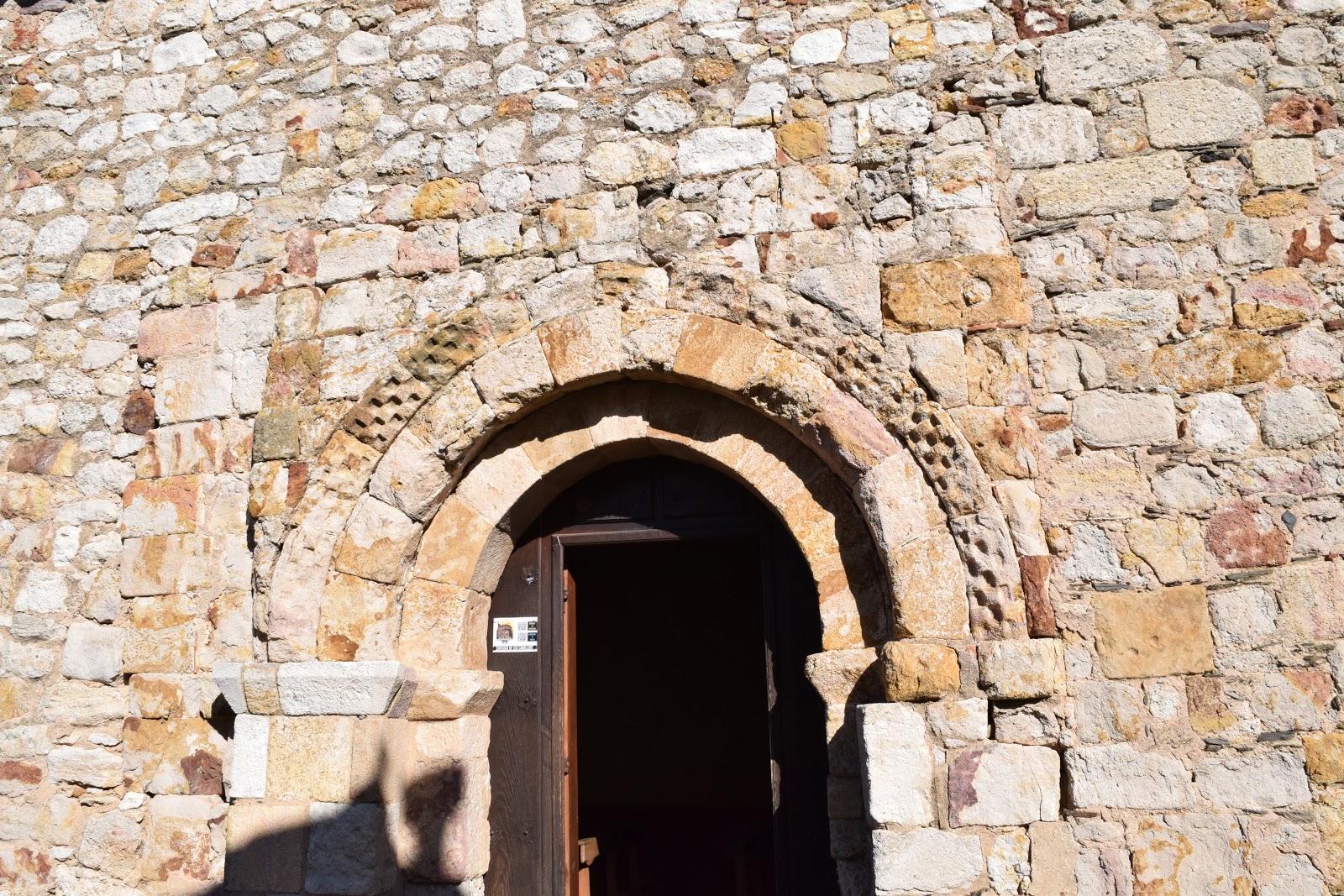
The front doorway is worth lingering over.
I had to content myself with a look around the outside of the impressive edifice. Without further ado, here are the sixteen wonderful miracles that happened in Salas, Huesca, in the thirteenth century.
A couple uses the enormous arcade as their own hangout.
Cantiga 43: A couple unable to have children makes the pilgrimage to Salas, offering his weight in wax for candles if Holy Mary will grant them a child. Sure enough, the wife has a beautiful son nine months after their return home to Daroca. But does she give the Virgin of Salas the promised wax? No, she waits seven years, raising her child as if he weren't a miracle for which she should give thanks. When he's seven, the boy catches a fever and dies. His father wants to bury him, but his mother says they should give him to Mary, along with the wax they promised so long ago. Six days later, they lay their son in his coffin before the altar, and tearing out her hair in grief, the wife asks Mary to sympathize with the loss of her son and bring him back. "Help me so I don't annoy you with my incessant pleas," she says! Upon this, the child is heard crying inside the coffin. The whole town comes to see the great miracle.
Salas and me
Photo 2019 Daniel Sanz
Cantiga 44: A nobleman loses his goshawk during a hunt. After searching far and wide for the valuable bird, the nobleman makes a wax goshawk and presents it to Our Lady of Salas at her altar, asking for the return of his raptor. He stays to hear mass, and before it's over, the goshawk flies into the church and alights on his hand as if it's ready to go hunting.
Having seen the church, I can imagine the way a hawk would fly around inside it. It's the perfect size, as you can see in the photo.
Cantiga 109: Five demons attack a man, relentlessly tormenting him. He heads straight to Salas, but when the church is in sight, the devils don't let him continue. Two friars arrive and help the man toward the church. After an antisemitic exchange of doctrinal value we would question today, the devils figure Mary will make them let go of their victim and head out of their own volition.
Cantiga 114: A woman is a great devotee of the Virgin of Salas. She always places long wax candles at her altar and asks for protection for her dear son. One day, the son's enemies beat him to a pulp, such that it's not likely he'll live to see the next day. His mother takes him home and bandages him, commending him to Holy Mary, who cures him at once. As soon as the bandages are on, the wounds disappear without even a scar. The son tells his mother to take the bandages off, and when they see the great miracle, they go to Salas to tell everyone about it.
Cantiga 129: In a fierce battle, a warrior receives an arrow right through his eye. It reaches the base of his neck, and all his companions think he's dead. But he's not. He tells them he'll make an offering in Salas if he's cured. So they pull the arrow out of his eye, and miraculously, he's fine. In fact, he can now see out of the eye better than he did before. He makes the pilgrimage to Salas, telling everyone about the beautiful miracle.
It looks like time for another reconstruction.
Cantiga 161: A vintner is in the habit of making pilgrimages to Salas, carrying an image of Holy Mary with him as a talisman. One day in August, at home, he sees a big storm coming. He takes the image to his vineyard and asks Mary to protect his vines. "I consider it to be yours, although my wife and I till it as our own," he says, making a celestially binding contract of fealty. The hail severely damages all the other vineyards in the area, but the one that's been pledged to Mary is spared. Further, tendrils that spread from that vineyard and intertwine with others in other vineyards are also spared, even though the rest of the vines in those other vineyards are broken.
Cantiga 163: A man in Huesca loses at dice and renounces Holy Mary. Upon speaking this blasphemy, he's crippled, unable to move or speak. Through signs, he asks to be taken to Salas, where he's able to speak enough to make a promise never to play dice again. His body is immediately healed and for the rest of his life, the man praises Holy Mary.
Cantiga 164: An innocent monk (a devotee of the Blessed Virgin) is accused of having his own money coined. The abbot, a nobleman with strong ties to Aragonese royalty, decides to have the monk arrested. The monk flees into the church at Salas, claiming sanctuary. The abbot calls the monk outside, and when he dutifully leaves the church, he's seized and thrown out of the churchyard. The image of Mary moves her Child away from her and gives a cry so loud that the earth trembles. Both figures pale and lose all their beauty. Everyone understands these phenomena as evidence of heavenly displeasure. The abbot orders the return of the monk and enters the church with all his men with ropes about their necks in penance. The Bishop of Huesca arrives and declares that amends must be made to Holy Mary. Upon this utterance, Mary clasps her Son to her again and shows that they pardon the abbot. However, the images never recover their color, as a reminder of how much the false arrest displeased them.
Cantiga 166: A man's limbs are twisted and he is paralyzed for five years. He promises that if he goes to Salas and gets well, he'll donate a large measure of wax every year. He is healed forthwith. He's able to walk to Salas nimbly, carrying the wax himself.
This cantiga has an especially fun melody that sounds good in all the versions I've heard. The above video has the advantage of having been filmed inside the sanctuary of Santa Maria de Salas! Watch it to glimpse what I was unable to.
Cantiga 167: The small son of a Moorish lady who lives in Borja dies from a terrible disease. The woman witnesses how the Christians go to Salas and hears of Mary's miracles. She decides to go to Salas herself with a wax son and her son's body. She keeps vigil all night before the altar, appealing to Mary's sympathy. Her son comes back to life, even though he had been dead for three days. The woman converts to Christianity.
This is another of my favorite melodies.
Cantiga 168: A woman in Lleida has several children, but loses them all within a short time. Her grief for the last one is so deep that she nearly goes mad. She begs Mary for him and waits for two days. When she sees he won't revive, she takes him to Salas and raises him up at the altar. The boy comes back to life right there in her arms.
This miracle was found in writing. Finding a miracle on the Iberian Peninsula in writing before the Cantigas got it down is unusual enough that the poets mention it what is almost certainly every time.
Cantiga 171: A barren couple promises to make the pilgrimage to Salas if they're granted a child. Of course, a lovely boy arrives. They raise him for two years and then set out on the promised pilgrimage. When crossing a river on horseback, mother and child fall into the water. Although the mother makes it out, they can't find the boy, no matter how hard they look. The husband thinks they should go home, but the wife says they should continue to Salas and complain. As they continue, the wife prays constantly for the Virgin's help. When they step inside the church, they see their son waiting for them at the altar.
Cantiga 172: A merchant sails to Acre in the Holy Land with a lot of good merchandise. He runs into a serious storm on the sea, and when he thinks all is lost, he promises to make a pilgrimage to Salas if he survives. The storm immediately calms. The mast is repaired, and they sail on to Acre without incident. Once they've sold their wares for good prices, everyone on the ship makes pilgrimages to Salas and also Puy.
Cantiga 173: A man is in mortal agony with kidney stones. He can't eat or sleep, only call on the Virgin Mary for help. No doctors are any help. He promises to go to Salas and falls asleep. (He appears to have a dream, but the text is missing.) He wakes up with a kidney stone as large as a chestnut in the bed with him.
Cantiga 189: A man goes on pilgrimage to Salas all alone. Darkness falls, and he meets a dragon. The man prays to Holy Mary, afraid that if he runs, the dragon will chase him. When he finishes his prayer, he runs at the beast with his sword and kills it. However, the blood that spurts out of the dragon's neck and splatters the man's face is poisonous. The man becomes like a leper. He continues to Salas and weeps piteously until he's cured.
The Cantigas are relentlessly realist within the context of the magical thinking that allows for miracles. This is the only cantiga that has a fantasy creature.
Cantiga 247: A girl is born blind. When she's ten years old, her father dies, and her mother gives the child to Holy Mary because she can't handle being a widow and caring for a blind daughter. The mother says that if Mary accepts, she should give the girl her sight. Although she can now see, the girl stays to serve Holy Mary.
Pyrenees foothills and one of many runners we saw in the area.
In these cantigas, there's a preponderance of candles and wax that could be used to make them. This Virgin also has a special talent for reviving children, so it's little wonder she enjoyed such wide-reaching devotion. The other miracle cures are likely bandwagon worshipers, who had no children or hadn't lost any but wanted to be in contact with this powerful Mary, anyway.
I had to content myself with an antique sign selfie because the miraculous
image was locked up tight.
When we visited the site, there was a plaque showing a pilgrimage route from France to Santiago de Compostela that went through Santa Maria de Salas, making the church an obligatory visit for any pilgrim--if it's ever open. Unlike the Villasirga cantigas, none of the Salas miracles mention Santiago. I can think of two good reasons. First, Salas is right on a Santiago pilgrimage route, while Villasirga is a bit off the direct path. Villasirga had to do publicity to draw in pilgrims, but Salas had a steady stream with no additional propaganda necessary. Second, the Cantigas are the product of the court of Alfonso X, el Sabio, King of Castile and León and many other territories north and south, but not of Aragón, where Salas is located. Alfonso X was related by marriage to Aragonese royalty, but why bother to promote an area that wouldn't bring economic benefit directly to one's Crown? That old Castilian pragmatism at work.
Santiago de los Caballeros in the middle of the Field of Truth,
seen from the castle
Photos in this post 2017, 2018, 2019 Jessica Knauss
When you visit Zamora, you're likely to see Santiago de los Caballeros for the first time as you gaze down at the Field of Truth from the eleventh-century city walls or the ruins of the castle. I sometimes take a little walk to get this this view and marvel that I live here. In this post, I'm sharing the oldest Romanesque structure in the city in order to celebrate my assignment to the same school in Zamora for next school year. (Three in a row! That's the longest I've stayed anywhere in decades!)
It's known as St. James of the Knights because throughout the Middle Ages, this was where squires came to do a nightlong vigil and be knighted in a ceremony the following day. The current structure has elements from the beginning of the twelfth century. The rudimentary north and western facades (seen above) are likely hasty reconstructions from the late twelfth century and later. Like other Romanesque churches here, it's made from lovely golden and rose-colored local stones. From afar, it looks small, an impression that doesn't change as you come closer.
Santiago's "good side" has the intact early twelfth-century apse.
The most famous knight to undergo the vigil and ceremony on this site was Ruy Díaz de Vivar, later known as El Cid (c. 1043 - 1099). A visit to Santiago de los Caballeros is a stroll through history and legend. To keep it short, it's said that after he discovered his king, Sancho I, had been assassinated, El Cid chased the murderer, Bellido Dolfos, from the Door of Loyalty (previously the Door of Betrayal) in the city wall near the castle into the field where Santiago de los Caballeros sits. There, El Cid apprehended Bellido Dolfos, and the open area has been called the Field of Truth ever since.
When I pointed out Santiago de los Caballeros and its connections to the famous hero, my friend said, "I didn't know El Cid was in Zamora." Come on, the first half of the El Cid film takes place in Zamora! Zamora, an open secret of spectacular history.
Santiago de los Caballeros below the castle and cathedral bell tower
In spite of its illustrious past, Santiago de los Caballeros gives off an air of humility today. Its placement near the river has exposed it to repeated flooding and continual repair. It seems each time it was repaired, the more basic the construction. The only decoration left to the twelfth-century entrance is that Romanesque predilection, a checkerboard pattern.
That's the caretaker.
Stepping inside, the small space creates intimacy. When the door is left open, it's more than enough to flood the space with light. It has two levels of floor, surely the result of building works at different points of sedimentary history. Both levels have medieval tombs under them.
Looking toward the foot, picture the plaster-covered walls replete with colorful paintings and you'll have a better idea of what Santiago was like when it was first built and used.
The lack of features in the rest of the building puts the focus on the parts that come to us directly from the early twelfth century: columns that might once have supported an arch, complete with capitals that are unique in Zamora; a triumphal arch some critics have said looks more like a doorway; and the tiny semicircular apse.
As usual, the meaty art is in the column capitals. The two large capitals before the apse both have simas with leaves, vines, and compressed palms not unlike the ones in San Claudio de Olivares. Many critics believe this is Asturian influence. To my eyes, it looks like a natural continuation of the sima tradition seen first in San Pedro de la Nave.
This first capital is worth viewing from every angle, such is the inscrutable confusion of forms.
Every interpretation I've read claims that this is a sculptural representation of Hell, complete with all manner of fornication. Is it Hell, or the earthly behavior that leads to that low place? Before reading about this capital, I thought it was acrobats, a popular subject in Romanesque sculpture with multiple interpretations. Given the chaotic nature of the composition, it's likely the most negative connotations are the correct ones. Acrobats could indeed represent sins of the flesh, but looking closer, the sins appear to be represented literally.
The inclusion of a horse on the side and heads of oxen in the sima further emphasize the theme of humans committing the sin of surrendering to their animal nature. I adore the numerous faces, the honest execution, and the inventiveness of the forms. Call me lurid, but this may be my favorite capital in Zamora.
Some Romanesque churches like to balance out the themes in their capitals by portraying opposite concepts across the aisle. Not so here. Clearly done by the same delightful artist, this capital shows the consequences of the actions in the first. The flames of Hell rise out of an Asturian-inspired rope decoration. Ropes are a continued theme as the tortured souls appear to be tied to the exotic beasts that punish them, with obvious allegorical value.
This poor fellow appears to be giving his tormentor a hug while it gnaws his hands off. This particular scene could have a subconnotation of the way time consumes all living things. But time is hardly a factor when you're enduring the eternal torments of the damned.
Turning our attention to the apse, the semicircular arch over the quadrilateral structure of the columns makes a perfect metaphor for the union between heaven and earth. The semicircular apse has three small windows and a stone checkerboard border. A simple table altar stands over the Renaissance tomb of one of Zamora's bishops. It would be hard to cram more sacredness into this limited space. During one of my visits here, I found this view to be as useful to a meditative state as a view of nature.
The triumphal arch has three fractional columns on each side, and their capitals line up in a row. On the left, delicately carved plant decorations that echo the simas, Adam and Eve after the original sin with the Serpent winding around them like a boa constrictor, and the expulsion from Eden.
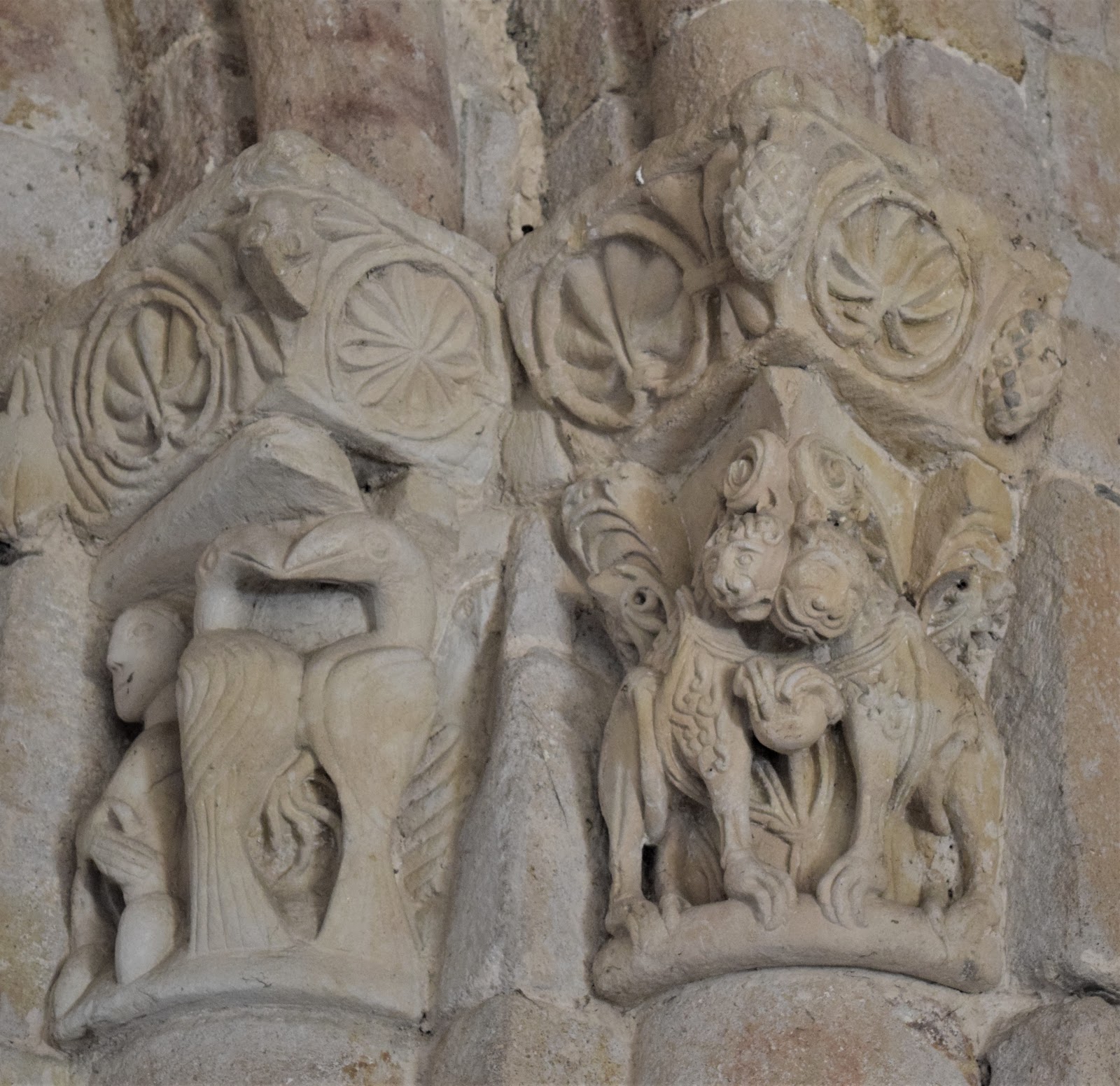
The Adam and Eve figures are strange and rudimentary, but the serpent symbolism is original. In this view, we see the other side of the expulsion capital, which has facing lions. Remember them.
What's left of Adam and Eve in the expulsion from Eden is again crudely executed, in the same style as the serpent capital. Rather than merely covering themselves with found objects, however, we can see Eve is wearing a tunic that, while basic, doesn't have to be held together with the hands. She still modestly crosses her arms in front.
On the opposite side, the same artist placed indistinct four-legged beasts, facing birds and a man, and facing lions in a jungle-like scene. The enigmatic man appears to be protected by the birds, barely visible behind them. Birds can be representations of the human soul, or they can protect the human soul, which is sometimes symbolized with an anonymous human being. I like this interpretation because the man's pleasant expression indicates he has no worries: these birds are protecting him.
The lions in this group are the best sculptures in the church. The lions on the other side appear to be rough drafts, and these the final development. Here we can see why the lion came to be called "king of the jungle." But the leaves and branches here aren't meant to represent just any plant. These lions are guarding the Tree of Life. Nobody's getting past those fearsome claws!
Santiago de los Caballeros is in use today. It's served by the same priest who gives mass in neighboring San Claudio de Olivares. It has endured the ravages of weather for about 900 years. For two years, I've had the honor of sharing space with it. Let's see how much longer we both last!
San Juan de Baños
All photos in this post 2019 Jessica Knauss
It might cheapen the effect to give you the money shot of this lovely historical building right at the top of the post. In reality, it's not something a casual traveler stumbles upon. Like most Visigothic monuments, San Juan de Baños is in a tiny locality not known for any other reason. I had to randomly hear about this, the only Visigothic church with a firm date, figure out where the heck Baños de Cerrato is, and then wait until I found a friend as crazy as I am about historical-themed road trips to take me there. Overall, there is a high risk of spending your time in the unique, fascinating small city of Palencia, never knowing what you missed.
San Juan de Baños has the feeling of being nowhere,
but it's right next to an industrial area.
This church is in this location for a specific reason. In January 661, King Reccesvinthus was returning to Toledo from fighting rebellious Basque tribes in the north and feeling rather poorly, as you well might in the early Middle Ages. The cortege stopped in Balneos (now Baños de Cerrato) because someone had heard of the curative waters there. It had been a spa town since Roman times. Reccesvinthus drank the water and felt much better. This miracle inspired him to found a water/baptism-themed church in that very spot.
The original dedication stone is up high and decorated with sunbursts.
The church still proudly displays the stone on which Reccesvinthus inscribed his dedication of the church:
A replica of the dedication stone is set where visitors can read it.
"The precursor of the Lord, the martyr Saint John the Baptist, owns this house, built as an eternal gift that I, King Reccesvinthus, devout worshiper of your name, dedicated to you, by my own right, in the third year after the tenth as illustrious companion of this kingdom. In the year 661."
Water quality is not guaranteed. That didn't stop my friend!
The fountain has fallen into disrepair and been rebuilt many times since Reccesvinthus's time, but the spring water has never stopped flowing. The latest reconstruction is from the 1940s, with two horseshoe arches that echo the architecture of the church.
Most of the stones here and especially the horseshoe arch
were put together in 661!
The building itself is in a remarkable state of conservation. The bell gable was added in 1865. Apart from that, the only extant features that are not from 661 are the roof, the jalousies (lacy stone window panes that must be modeled on pre-Romanesque buildings I adore in Oviedo), and the floor.
The geometric floral friezes in the door will be echoed inside.
Archaeologists took advantage of the rehabilitation of the floor to dig around and find many wonderful items that are now housed in the Museum of Palencia, such as Visigothic burials and a curious tile. It showed up in the excavations with an imperious hand print, giving rise to the legend that it was Reccesvinthus's way of signing the church he ordered to be built. Whosoever possesseth a hand that fitteth into the impression exactly shall be named new King of the Visigoths. As you can see, my friend is now King Daniel of the Visigoths. I tried too, but my pinkie was too short. The page pictured next to the replica says only that a perfect fit will give the hand's owner good luck. I guess they're not ready to hand the crown over, even though the kingdom no longer exists!
The main altar. The wooden roof is made to
look as it might have in Visigothic times.
When you enter, the space is not large, but the simple lines of construction produce a sense of vastness. Horseshoe arches dominate the scene, proving that the Iberian Peninsula did not have to wait until the Arabs and Berbers took over in order to grace its buildings with this pleasing shape. We see them in the grand arch of the main altar, the windows, and between eight columns.
The guide says the lateral arches are slightly irregular, but you would really have to look to spot the flaws. The impression is of stately harmony.
The marble columns have been harvested from Roman villas that have long since disappeared. Most if not all the stones used in the rest of the church are also likely recycled from Roman buildings. In this way, the Roman legacy has come down to us today, only slightly altered.
The recycled Roman capital is right next to the main altar.
One Corinthian column capital has been identified as a late Roman carving based solely on its style.
The other capitals are also Corinthian style, but the execution is less ornate. The guide seemed to think the Visigothic artisans were unable to produce the same level of detail as their direct Roman forebears. Having studied the purposeful simplicity of Romanesque art as contrasted with the complexities of the Gothic area, I appreciate the clean lines of the Visigothic capitals and believe the differences between them and the Roman one are due to taste.
I especially like this capital because the interpretation of the Corinthian pattern is so free, and because the diminutive four-petaled flower in the center inserts the new Christian symbolism into an ancient context.
Lest we think the ancient and medieval world was all bare stone, the guide was careful to point out the paint traces. Medieval people did not want to look at their construction materials in their finished edifices any more than we would want to stare at rebar or insulation. They filled their buildings with color and shapes! Here you can also appreciate the geometric flower friezes, repeated throughout the building, inside and out. Interest, focal points, horror vacui, it's all here, in this seemingly simple space.
In keeping with the baptism theme, San Juan de Baños boasts an ancient baptismal font, exactly the kind of thing I imagine Mudarra using in Seven Noble Knights. The lack of decoration makes it hard to date, but the guide said the best guess places it between the fifth and sixth centuries. Adults would have stripped down and stepped right in to be initiated into the Christian church.
A replica of Reccesvinthus's votive crown is hanging in the space it was probably meant for. I've seen the original at the National Archaeological Museum in Madrid and admired the fine metalwork and precious jewels. The sight of the replica in situ moved me deeply.
San Juan de Baños is consecrated, but is only used for visits like this and for weddings. It would be an exceptionally elegant place to say vows, in my humble opinion.
The foot of the church with the door
and the guide's station.
Palencia is the host of one more of these rare pieces of Visigothic architecture, and it has another legend attached to its founding, so check this space for more!